Polarity Music Tutorials
This is the full archive for Polarity music-production tutorials, Bitwig videos, patch ideas, and workflow notes.
If you want the combined timeline with guides, helpers, articles, music videos, and releases, go back to the full backlog.

This video demonstrates how to modulate filter frequencies in Bitwig (or any modular DAW) so modulation lands on musical notes within a chosen scale, not just random frequencies, by using harmony theory and quantizers. The key insight is that most Western scales are constructed by stacking perfect fifths (seven semitones apart), so you can use a quantizer set to six steps and a modulation range of 42 semitones to achieve accurate, in-scale modulation, with an initial frequency offset depending on your root note. This method provides a musically meaningful way to randomize your sound design while always staying within your chosen key, and is applicable to any environment that allows semitone-based modulation.

In this video, I demonstrate a custom-built FFT resynthesizer and note extractor inside Bitwig Studio, which uses pure sine oscillators to extract and recreate audio frequencies without traditional bandpass filters. The system allows for unique spectral manipulation, including stretching sounds, octave shifting, and removing partials outside a selected musical scale, making it perfect for ambient effects and creative sound design. I also show how this setup can extract MIDI notes from audio and explain the straightforward method behind building it, with presets available for free download.

Temperance Light is a plugin marketed as a revolutionary musical reverb, but it essentially combines a reverb with a filter, offering a polished look but limited flexibility. In Bitwig Studio, you can easily recreate and expand on its features using onboard devices, allowing for much more customization, like choosing your own reverb, filter types, and even adding delays. By building this effect yourself, you gain deeper creative control and a better understanding of sound design, rather than being restricted to a single, fixed plugin.

This video highlights why Bitwig Studio stands out for its hands-on modularity, allowing users to easily create unique instruments and effects without coding or complex visual languages. Bitwig’s flexible modular system empowers both beginners and advanced producers to experiment, learn synthesis fundamentals, and develop custom sounds beyond what preset-heavy plugins offer. The creator emphasizes the value of creativity and learning through Bitwig’s tools, making it an ideal choice for anyone seeking a customizable and educational music production environment.

In this walkthrough of Bitwig Studio 6, I demonstrate how to use the new global scale feature to create dynamic and interesting sequences by combining a variety of note effects and MIDI processing tools. By relying on note FX like arpeggiators, randomizers, and quantizers, you can quickly generate complex basslines, melodies, and pads that always stay in key, making generative and experimental music workflows much more accessible. This approach allows you to break out of repetitive habits and explore fresh melodic ideas without being tied to manually drawing notes, harnessing the power of modulation and scale quantization for creative results.

This video reviews the Infinite plugin, a free AI-powered tool, likely made by Google, that generates an endless stream of music based on user prompts and context, allowing detailed control over the composition process. The creator acknowledges concerns about AI, such as data usage from artists and environmental impact, but is interested in exploring its creative potential and hopes for future open-source or local versions. Overall, the plugin inspires fresh ideas and background textures for musicians while letting them directly shape the generated output, despite some technical limitations and the broader uncertainties about AI in music creation.

In this video, I demonstrate how to recreate the functionality of the popular hardware device, the High Court, inside Bitwig, allowing you to play and modify diatonic chord progressions using your keyboard instead of spending hundreds on the physical unit. I showcase how to set up and use my Bitwig preset for easy chord selection and modification, and how to record the results into a MIDI track. You can download my free preset from GitHub, and I'm open to feedback or requests for additional features or Bitwig Studio 5 compatibility.
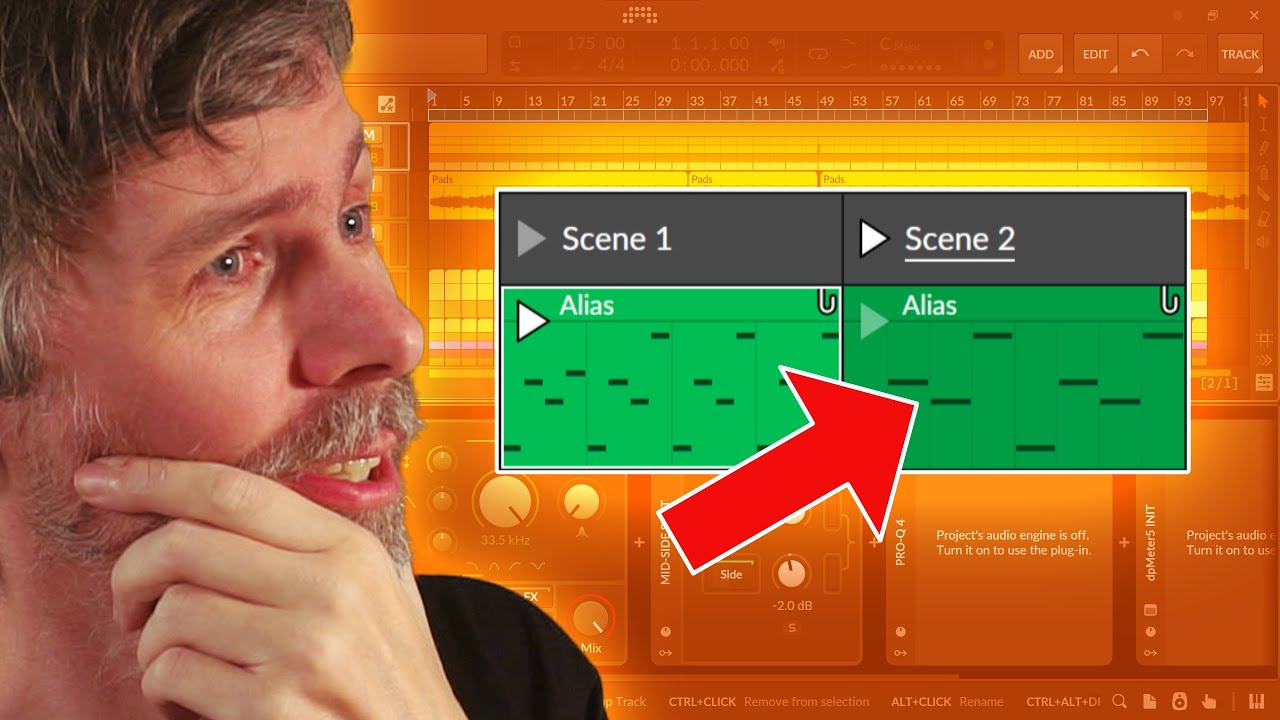
This video explores the alias clip feature in Bitwig, which allows users to copy and link clips so that changes to one affect all linked versions, but highlights potential issues with accidental changes in complex projects. The presenter appreciates the flexibility of being able to alter container properties like length or start position without changing the clip's contents and sees potential if alias clips could span across different tracks. They suggest improvements such as more inspector controls and cross-track aliasing, but personally prefer working with unique clips rather than relying heavily on the alias feature.

In this guide, I demonstrate how to use Bitwig Studio 6’s global scale and a custom preset to automatically transpose notes to the correct root when switching scales, solving the tedious process of manual transposition. By leveraging the note grid and new modules like root key and pitch class, you can easily adapt your melodies and harmonies across changes in key signatures. This method lets you freely compose in different scales without worrying about root note adjustments, making scale modulation seamless and creative.

Automation in Bitwig Studio 6 introduces improved visuals and helpful new tools, but the workflow changes, like moving buttons and making it harder to see MIDI notes or quickly add/delete automation lanes, can be frustrating, especially for users familiar with Bitwig 5. Despite some minor design annoyances and added clicks in the process, the enhanced features such as randomization, smarter node handling, and flexible clip-based automation are genuinely powerful and enjoyable. Overall, the automation system is much improved, though small fixes to workflow consistency would make it nearly perfect.

Bitwig Studio 6’s new scale highlighting feature makes it easy to visualize, create, and modulate melodies and harmonies in different scales and modes, helping both beginners and advanced users make more intentional music. The feature supports global and local scale selection, real-time automation, and integration with tools like arpeggiators and note effects, allowing users to experiment with brightness, darkness, and complexity. While primarily a highlighter rather than a full automatic transposer, it’s a valuable addition for making music theory more accessible and practical in your workflow.

Explore the main new features in Bitwig Studio 6, including alias clips, automation upgrades, scale tools, editing changes, and workflow improvements.

Bitwig Studio 6 has finally arrived, bringing a host of powerful new features, especially major automation improvements like automation clips, aliasing, and advanced editing tools that put automation on par with audio and note editing. The update also introduces global key signatures, enhanced note expression capabilities, and an updated dark interface, making both workflow and creative possibilities much more flexible and efficient. Overall, this release delivers numerous small and large improvements across the board, ensuring a snappier, more inspiring experience for all users.

After a year-long break, I'm back with a test stream to prepare for the highly anticipated launch of Bitwig 6, making sure my setup and chat integration work smoothly. The Bitwig community is buzzing with excitement for new features, and I'm ready to go live as soon as the beta drops to showcase and discuss everything in real time. Personally, I'm most interested in improvements to modularity, the grid, and workflow enhancements, and I enjoy the interactive, niche atmosphere we share here.
How much does Bitwig Studio cost, what does the upgrade plan include, is Bitwig free, and when should you renew or upgrade? This guide explains Bitwig pricing and licenses in plain English.

Today I compared three spectral compressors, DSEQ3, Spectral Compressor, and Spectraft, explaining my preferences, typical use cases, and cautioning against overuse due to their potential to strip music of its character. I prefer DSEQ3 for its smart AI features, custom threshold curves, and affordability, but use Spectral Compressor mostly for spectral sidechaining and find Spectraft to be the most versatile, albeit pricey. Ultimately, I advise subtlety with these tools, emphasizing that a well-balanced mix done at the track level always sounds better than heavily processing the master.