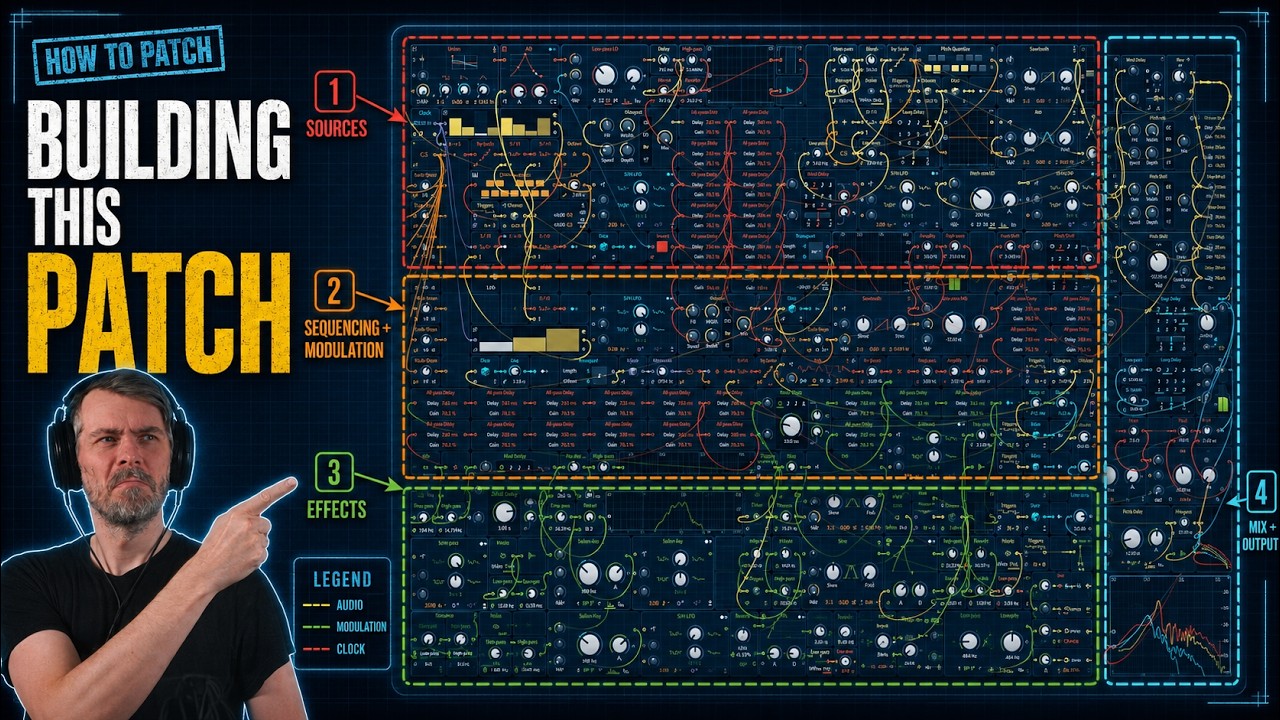
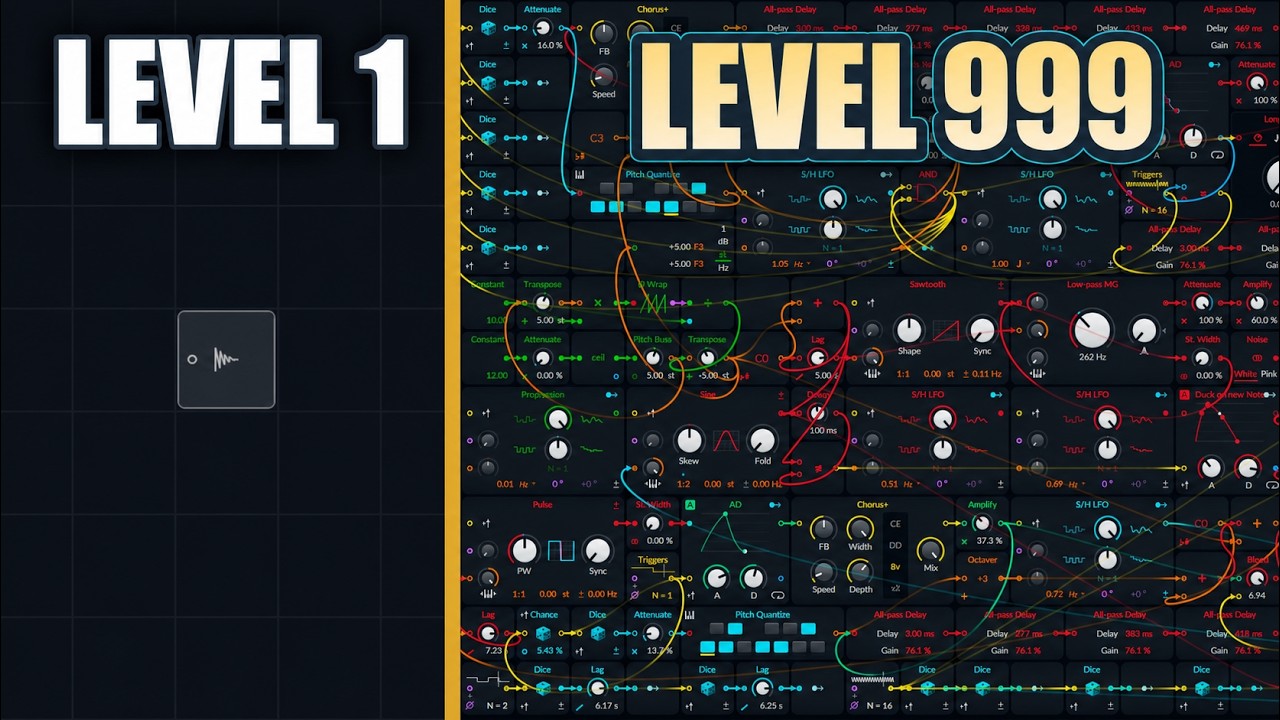
Bitwig Grid Additive Ambient Patch with Generative Bass
Tutorial | Jul 14, 2026
Build a Bitwig Grid additive sci-fi drone and bass patch by replacing low saw harmonics with sine partials and learning layered random modulation workflow.
- You can watch the Video on Youtube
- Support me on Patreon if you like what you hear.
- Download Presets, Tools and Projects on my Dispenser
Quick Answer #
- Patch type: Generative Bitwig Grid additive oscillator / ambient sci‑fi texture patch, built from multiple Sine Oscillators summed into a custom harmonic source.
- Main sound-design direction: Replaces the lowest saw partials with hand-controlled and randomized first 6 harmonics, then blends the higher harmonics back in via a high-pass filtered saw for a hybrid additive/subtractive tone.
- Key modules/devices: Sine Oscillator, Saw Oscillator, Mixer, Attenuate, Oscilloscope, Spectrum Analyzer, VU Meter, AD envelope, Dice, Sample & Hold, Chance, Quantizer/Scalar, SVF / HP8 / low-pass / notch filters, chorus, delay, large custom reverb/all-pass network.
- Core modulation ideas: Harmonic amplitudes are retriggered in phase, randomized per event with Dice, pitch is constrained to a scale, triggers are probability-shaped, and slow modulation adds pitch wobble, filter motion, sequence variation, and occasional lead/bass events.
- Practical result: A Blade Runner / cyberpunk-style evolving drone-bed with bass movement, sparse melodic fragments, metallic overtones, and spacious reverbs, useful as a background layer, soundtrack texture, or generative ambient foundation.
Build Overview #
The session begins with a simple additive synthesis concept: several sine oscillators are tuned to the first few harmonics of a played pitch, phase-reset together, and mixed with independent amplitude control. This creates a custom low-frequency harmonic block whose overtone balance can be changed or randomized at each retrigger. A saw wave is then high-passed so its lower partials are removed, letting the hand-built sine stack replace the first harmonics while the saw supplies the upper spectrum. The result is a hybrid oscillator structure with controllable harmonic content, visible in both scope and spectrum displays.
From there, the patch grows into a generative ambient instrument. Random triggers, sample-and-hold, quantized pitch selection, slow modulation, pitch drift, filter motion, and probability-based events are added to keep the harmonic mix, note choices, and articulation in flux. Additional layers such as bass movement, melodic fragments, chorus, delay, and large reverb networks gradually turn the oscillator experiment into a cinematic, Blade Runner-like texture. Along the way, the build also addresses practical modular concerns such as retrigger timing, event density, excessive brightness, gain staging, and CPU-heavy organization.
This kind of open-ended patching process is useful for learning modular synthesis because it shows how a strong sound design idea can serve as the center of a much larger system. Rather than following a fixed recipe, the patch evolves through testing, listening, correcting problems, and repurposing modules as new needs appear. That makes the session valuable not just for the final sound, but for demonstrating modular thinking: constructing functions from basics, combining control and audio-rate signals, and shaping complexity in stages until a coherent instrument emerges.
Patch Decisions #
- Built a custom additive oscillator from six Sine oscillators tuned to the 1st through 6th harmonics of the incoming pitch, mixed together and hard re-triggered from a button/trigger so all partials restart in the same phase.
- Put an Attenuate after each sine before the mixer so each harmonic could be brought in/out around a fixed offset without relying on mixer gain ranges; the fundamental was kept always on while upper partials were varied.
- Layered this additive low-end with a Saw oscillator, then used a pitch-tracking high-pass filter on the saw to remove its lower partials and let the custom sine stack replace the first harmonics; tried steeper filtering (SVF / high-pass 8, even doubling filters) as a compromise to better separate the layers.
- Added random overtone selection on retrigger using Dice modulators sent to the harmonic level controls, so each trigger produced a different combination of upper partials while preserving the base pitch.
- Introduced a triggered voice/event structure with an AD envelope, then used logic/math gating to avoid bursts of rapid retriggers by only allowing new triggers when the envelope/output had returned to zero.
- Created a constrained pitch generator with random sources + quantization, restricting note choices to root, fifth, and fourth, then quantizing/transposing into E♭ minor / black-key scale; added sample-and-hold to stop unwanted glide between random pitch changes.
- Added slow pitch instability by modulating transpose with a smooth random source through bipolar + lag/slide, producing gentle pitch wobble rather than stepped detuning.
- Built a large ambient FX chain by copying in a previous Grid reverb/feedback structure and later extending it with chorus, delay/echo, all-pass diffusion, and extra feedback paths, aiming for a long sci-fi / Blade Runner-like wash; later reduced some send/feedback amounts because parts became too loud or too dense.
- Added a randomized melodic layer/sequencer using Dice + counter/indexed note selection, with sequences refreshed every 8 or 16 bars, plus random trigger chance so lead fragments appear intermittently instead of continuously.
- Made several cleanup compromises during the build: lowered overly high pitches, inserted low-pass / high-pass filtering to tame harshness and sub buildup, reduced trigger chances when “2%” events were still firing too often, and accepted that some reverbs/delays were too long or CPU-heavy but left deeper retuning for later.
Interesting Moments #
- 00:00:05 - Additive oscillator build begins with stacked sine harmonics
- 00:05:28 - Saw layer high-passed to replace low partials with custom harmonics
- 00:08:45 - Random retriggered overtone sets create a new timbre each hit
- 00:09:47 - Pitch quantizer added for root, fifth, and fourth movement in E♭ minor
- 00:12:10 - Core idea explained: replace first 6 harmonics, let saw provide the rest
- 00:14:31 - First full ambient test with the custom reverb patch
- 01:08:24 - “Blade Runner” sci-fi vibe appears after mix and FX tweaks
- 01:09:34 - Melody sequencer section starts with randomized repeating patterns
What This Build Is Useful For #
What this Grid build is useful for #
This Bitwig Grid patch is useful for sound designers and ambient, sci-fi, experimental, and cinematic producers who want a controllable custom oscillator rather than relying on stock waveforms. It shows how to build additive low harmonics with synced sine oscillators, replace part of a saw spectrum with custom partials, and shape the result with pitch-tracked filtering, random retriggers, sample-and-hold, probability, and layered reverb/delay.
Patch builders can reuse several techniques: harmonic stacking, phase reset for consistent transients, partial randomization on trigger, note generation with quantizers and counters, trigger conditioning to avoid bursty repeats, and separating low-frequency tone design from higher-frequency texture.
A long-form process is more useful than a short tutorial when the goal is to understand decision-making, debugging, layout, and iteration inside a large patch. It helps when learning how complex Grid devices evolve, why modules get added or removed, and how rough ideas become playable systems.
Transcript #
This is the transcript of the video. The text was generated automatically and may contain small mistakes. The timestamps jump to the matching part of the video.
Click to expand transcript
[00:00:00] Okay so let's start something new. I have a rough idea for the start at least but
[00:00:05] not not really fully grid devices. So today I want to use multiple sign oscillators
[00:00:18] to make something additive maybe in the beginning at least. So let's take what
[00:00:26] do we use pitch? We start just with the pitch. I probably replace this later on so
[00:00:34] we take the pitch. We don't need the pitch input also here. That, that. Then we take
[00:00:44] an oscilloscope and we need to mix. Mixer. So we can see what we're doing or maybe
[00:01:00] a spectrum analyzer also. And here we take huge as a resolution. Okay so here we
[00:01:13] have the same frequency. This is the first harmonic, second one, third. And third
[00:01:21] harmonic. Four, five, six. Should be enough actually. Then we want to change the
[00:01:39] amplification here. And we want to re-trigger this. Let's use the button
[00:01:50] first. Right so each oscillator starts exactly in the same phase position at
[00:02:01] least. We have this kind of output here. And then we can influence. I use an
[00:02:13] attenuate here because the mixer right goes to zero and then plus six and minus
[00:02:19] infinity. But here we can say no, yes, no, yes and everything in between. So this
[00:02:26] is the fundamental here. It's that. Of course we want to modulate this of course
[00:02:34] over time. And I take a VU meter. We can see, oops, we can see which kind of
[00:02:49] overtone is active at which given time or it's actually connected. Oh no, it's not
[00:02:54] connected. Like this. Not connected. Okay now we can bring in or bring out these
[00:03:12] overtones and get a different sound.
[00:03:18] And now you can see here it's changing because C3 is not the pitch of the whole
[00:03:26] grid anymore. So this one, if this is here at pitch, it takes always the pitch
[00:03:31] window of the given input. At the moment it's C3. So when I play a different note
[00:03:38] on the keyboard, this of course takes a different pitch window. But when I change
[00:03:42] it inside of the grid, the grid module or device itself doesn't change the pitch
[00:03:48] so you can see here it's moving then because it's outside of the window. So
[00:03:54] let's leave it for that here inside of the window. Then we take an output for now
[00:04:04] and test it.
[00:04:26] Okay, so we have here, yeah, we can basically change the harmonics.
[00:04:33] Maybe it would be better to dial in here some kind of slope.
[00:04:49] Something like that. If we take here a song, I use a different color, and overlay this with the same pitch, I would say.
[00:05:10] You can see, you completely replace here the first six fundamentals. You can maybe
[00:05:28] high pass this with SVF and also take the pitch here. So now the pitch is basically
[00:05:42] at the fundamental here, right, to cut off. That's a high pass. High passes here. Then
[00:05:48] we can go up, right, and then we blend out here the lower partials. But I use a steeper
[00:05:56] filter, maybe this one, high pass 8, and it's better. So we can say we want to
[00:06:04] remove from the saw actually all these lower fundamentals and want to replace it
[00:06:11] with our thing here.
[00:06:33] Something like that. Let's see how this sounds when we mix it together.
[00:06:40] Mixer, this one, and this one.
[00:06:58] But now we can kind of change here what we have in the lower frequencies.
[00:07:11] Actually, can I make this a bit steeper here when I use two filters? A little bit.
[00:07:18] Not really. Let's try it out for that.
[00:07:40] And now we modulate here the overtones. It's already a bigger patch. Maybe we don't
[00:07:57] modulate it to use maybe a dice when we retrigger. Then we take a modulator out.
[00:08:10] This one defines, we leave the fundamental always on.
[00:08:18] Right, so with this attenuate I can just fully modulate without losing here the
[00:08:26] offset. And I can easily just drag all the way up enough, 100%, and not go into
[00:08:34] the positive range here, plus 60B or whatever. Okay. So now that we have this,
[00:08:45] we can try first to retrigger this multiple times here. See what comes out.
[00:08:52] 8, we want to go down to 85. We use an AD maybe at the end. This is basically one
[00:09:04] oscillator here. I'm building a custom oscillator more or less where we can
[00:09:07] change the overtones. We retrigger here. And then every time we replace this with
[00:09:22] the trigger, and then we can go in here. So we get an every trigger, we get a
[00:09:29] different set of combinations of overtones. Looks always a bit different.
[00:09:38] Then we can use another dice.
[00:09:47] What's the pitch quantizer? Only go for the root, the fifth, and the fourth.
[00:10:07] Then transpose this up from C3 up to D#3. Or maybe don't make it manually. We add
[00:10:20] the root to it. So now we transpose this. Okay, then we take another pitch
[00:10:32] quantizer. It's not really needed, but it helps sometimes to visualize what's going
[00:10:38] on. Because we want to go to EB minor. As you can see, we play here now different
[00:10:51] notes in the scale of EB. It's all the black keys. And then we use a scalar. So we
[00:10:58] are in the right mode. Okay, so we have no pitch here. And then we take all of this
[00:11:09] with double-click. Move it over here.
[00:11:16] Then we can modify the tenure. Oh, we need a sample and hold. There's a bit of
[00:11:29] glide everywhere.
[00:11:46] So what it does is we were placing here the lower fundamentals. And then when we
[00:12:10] run out of fundamentals here with the sixth one, we just replace it then with
[00:12:14] the top fundamentals from a saw. So that's the genius idea for the day.
[00:12:23] So this is, of course, way too fast. So we go down to maybe four and a chance
[00:12:36] module. So it's not triggering all the time.
[00:12:41] And then we do your maybe a slow ramp up. And then we again put this into FX
[00:12:54] processor, which is basically just a reverb or maybe a bunch of what's the
[00:13:02] name all past devices. Maybe we can create a new kind of reverb, but I could
[00:13:07] also just take the reverb from the last video this one here. Just take here the
[00:13:23] reverb probably here. This is also out of the. Yeah, I cannot just not only want to
[00:13:41] have this part here. This and this. Okay, let's copy it. Go back in here. Looks like
[00:13:52] this. Okay, let's see. This is connected. Input going that and then after this we
[00:14:01] go on that. Okay, got it. So we have this output here. Go in there. See all the sounds.
[00:14:31] (dramatic music)
[00:15:01] (dramatic music)
[00:15:04] Okay, the pitch is too high.
[00:15:07] It's actually not a problem,
[00:15:08] but we can maybe filter this with the low pass in.
[00:15:13] We also want to have the filter moving with the pitch.
[00:15:19] And maybe we go here one
[00:15:31] octave higher or one partial higher,
[00:15:34] which is instead of C3, we go to C4.
[00:15:39] Or we take an ratio knob and connect this.
[00:15:45] We can filter exactly at which point
[00:15:51] we want to cut the frequencies.
[00:16:01] (dramatic music)
[00:16:04] And we probably want to have a bit of pitch wobble.
[00:16:19] So I use the transpose here.
[00:16:22] And use a random, yeah, smooth.
[00:16:32] Hurt, bring it down, and bipolar, and slide.
[00:16:37] (dramatic music)
[00:16:41] That's actually, would be nice to have here a pitch input
[00:16:52] so you can see how the cycle looks like in different pitches,
[00:16:57] but we don't have it.
[00:17:01] (dramatic music)
[00:17:04] And here also problem is that we have sometimes multiple
[00:17:20] triggers very quickly, quickly one after the other.
[00:17:24] So we can say logic or math.
[00:17:30] So the output only when here the sequences down to zero,
[00:17:35] right?
[00:17:36] Second input is clear, so it's zero.
[00:17:41] So when this one here goes to zero,
[00:17:44] then gives, give out a trigger,
[00:17:46] then allow here this to happen.
[00:17:52] This makes sense here.
[00:17:57] We need to have a long delay because it's a feedback.
[00:18:00] Bring it down.
[00:18:03] So a trigger happens only when this kind of envelope here
[00:18:10] is at the low state or at the zero state.
[00:18:14] In between, it's not possible to retrigger.
[00:18:18] So it always needs to wait until the envelope settles down,
[00:18:24] or comes down, so we prevent kind of multiple triggers
[00:18:29] within one sequence.
[00:18:31] (dramatic music)
[00:18:34] You can hear the pitch wobble.
[00:18:47] (dramatic music)
[00:18:59] And here, maybe make this a bit stereo.
[00:19:04] (dramatic music)
[00:19:08] Here's the chorus also on here.
[00:19:29] (dramatic music)
[00:19:31] Nice.
[00:19:40] (dramatic music)
[00:19:42] So this is one effect.
[00:19:56] (dramatic music)
[00:19:59] (dramatic music)
[00:20:01] Let's try pitch shifter also here in the beginning.
[00:20:10] Pitch this down one octave.
[00:20:12] (dramatic music)
[00:20:15] Let's go to 45%.
[00:20:21] (dramatic music)
[00:20:29] (dramatic music)
[00:20:31] Should we use a frequency shifter?
[00:20:43] Maybe it's too much.
[00:20:45] (dramatic music)
[00:20:47] Um.
[00:20:53] (dramatic music)
[00:20:59] (dramatic music)
[00:21:01] You can hear the modulation.
[00:21:10] (dramatic music)
[00:21:12] (dramatic music)
[00:21:29] (dramatic music)
[00:21:31] Kind of sounds nice.
[00:21:39] Yeah, so we need to modulate this, obviously.
[00:21:42] (dramatic music)
[00:21:45] But also with a random modulator.
[00:21:47] (dramatic music)
[00:21:50] Not all the way up just to, I don't know, 98, 99.
[00:21:57] (dramatic music)
[00:22:01] 0.999.
[00:22:02] (dramatic music)
[00:22:05] That's maybe too much.
[00:22:12] (dramatic music)
[00:22:28] (dramatic music)
[00:22:31] So we have sometimes some kind of artifacts in the reverb.
[00:22:35] (dramatic music)
[00:22:38] (dramatic music)
[00:22:57] (dramatic music)
[00:23:00] Let's try and use here another delay, yeah?
[00:23:08] (dramatic music)
[00:23:10] Oh yeah, and we need them high and low pass.
[00:23:27] In the beginning.
[00:23:28] (dramatic music)
[00:23:32] Everything below 200 yards we don't want.
[00:23:34] (dramatic music)
[00:23:37] And the low pass, everything, maybe,
[00:23:41] to shoot above two kilohertz.
[00:23:44] (dramatic music)
[00:23:57] (dramatic music)
[00:24:00] It's already kind of complex, huh?
[00:24:07] (dramatic music)
[00:24:27] So, we filled out everything.
[00:24:29] (dramatic music)
[00:24:32] 80%.
[00:24:51] (dramatic music)
[00:24:57] (dramatic music)
[00:25:00] Now we maybe need an high pass.
[00:25:12] Looks like a bit there as an offset.
[00:25:16] (dramatic music)
[00:25:27] (dramatic music)
[00:25:29] (dramatic music)
[00:25:38] Okay, so let's try and use,
[00:25:52] what do we use, a wavetable?
[00:25:55] (dramatic music)
[00:25:58] And we,
[00:26:09] we don't want to use the sequencer.
[00:26:18] Or maybe use a pictures module
[00:26:25] to define some kind of melody here.
[00:26:27] (dramatic music)
[00:26:30] (keyboard clicking)
[00:26:55] (dramatic music)
[00:26:57] (keyboard clicking)
[00:27:02] Want to use unison?
[00:27:08] 80.
[00:27:12] (dramatic music)
[00:27:15] (keyboard clicking)
[00:27:20] (keyboard clicking)
[00:27:25] (dramatic music)
[00:27:27] (keyboard clicking)
[00:27:35] Want to use a scale and we want to use it the same.
[00:27:39] (dramatic music)
[00:27:55] (dramatic music)
[00:27:57] And to fill it down.
[00:28:10] (dramatic music)
[00:28:12] Yeah, we need to pitch.
[00:28:21] (dramatic music)
[00:28:26] (phone ringing)
[00:28:28] (dramatic music)
[00:28:31] (upbeat music)
[00:28:55] (upbeat music)
[00:28:57] We want to use the same reverb here.
[00:29:04] (dramatic music)
[00:29:06] (keyboard clicking)
[00:29:09] (dramatic music)
[00:29:12] (dramatic music)
[00:29:22] (upbeat music)
[00:29:25] Now the reverb is too much.
[00:29:38] Too much reverb.
[00:29:42] So we do a difference one here.
[00:29:45] (keyboard clicking)
[00:29:52] (dramatic music)
[00:29:55] (upbeat music)
[00:30:22] (upbeat music)
[00:30:25] (keyboard clicking)
[00:30:31] (keyboard clicking)
[00:30:36] (upbeat music)
[00:30:52] (upbeat music)
[00:30:55] Octave.
[00:31:06] (upbeat music)
[00:31:23] (upbeat music)
[00:31:26] And let's see if I can do something decent
[00:31:29] without using a calculator.
[00:31:31] (upbeat music)
[00:31:52] (upbeat music)
[00:31:55] Scale steps.
[00:32:11] Let's see how this sounds.
[00:32:13] (upbeat music)
[00:32:16] (keyboard clicking)
[00:32:22] (upbeat music)
[00:32:25] (keyboard clicking)
[00:32:38] (upbeat music)
[00:32:41] (keyboard clicking)
[00:32:44] (upbeat music)
[00:32:52] (upbeat music)
[00:32:55] (dramatic music)
[00:33:00] (keyboard clicking)
[00:33:13] (upbeat music)
[00:33:22] (upbeat music)
[00:33:25] (keyboard clicking)
[00:33:34] (upbeat music)
[00:33:52] (upbeat music)
[00:33:55] I try another pitch shift here.
[00:34:22] (upbeat music)
[00:34:25] (keyboard clicking)
[00:34:32] (upbeat music)
[00:34:35] (keyboard clicking)
[00:34:45] (upbeat music)
[00:34:52] (upbeat music)
[00:34:55] Now let's try out the chance module.
[00:35:15] (upbeat music)
[00:35:23] (keyboard clicking)
[00:35:26] (upbeat music)
[00:35:31] (keyboard clicking)
[00:35:42] (upbeat music)
[00:35:52] (upbeat music)
[00:35:55] Oh, maybe I use...
[00:36:10] (upbeat music)
[00:36:12] Everything again here.
[00:36:17] (upbeat music)
[00:36:23] Oh.
[00:36:24] (upbeat music)
[00:36:27] (upbeat music)
[00:36:29] (upbeat music)
[00:36:32] (upbeat music)
[00:36:34] (upbeat music)
[00:36:37] (upbeat music)
[00:36:40] (upbeat music)
[00:36:42] (upbeat music)
[00:36:45] (keyboard clicking)
[00:36:48] (upbeat music)
[00:36:49] Let's mute this for a moment.
[00:36:51] (upbeat music)
[00:36:53] (upbeat music)
[00:36:59] Oh, but it's always the same three notes, right?
[00:37:10] (upbeat music)
[00:37:21] (upbeat music)
[00:37:25] And I don't want to have this here.
[00:37:28] (upbeat music)
[00:37:30] (keyboard clicking)
[00:37:33] (upbeat music)
[00:37:36] (keyboard clicking)
[00:37:42] (upbeat music)
[00:37:52] (gentle music)
[00:38:21] (gentle music)
[00:38:23] (keyboard clicking)
[00:38:30] (gentle music)
[00:38:49] Maybe I'll use something different here.
[00:38:52] (keyboard clicking)
[00:38:55] (gentle music)
[00:39:02] And the byte is hard to control with the overtones.
[00:39:14] (gentle music)
[00:39:19] (gentle music)
[00:39:22] And I want to have you actually
[00:39:27] (gentle music)
[00:39:30] different pitches.
[00:39:31] (gentle music)
[00:39:34] (keyboard clicking)
[00:39:43] (gentle music)
[00:39:49] (gentle music)
[00:39:52] (keyboard clicking)
[00:39:55] (gentle music)
[00:39:57] (gentle music)
[00:40:00] (gentle music)
[00:40:02] (gentle music)
[00:40:05] (gentle music)
[00:40:08] It's nice overtones.
[00:40:10] (gentle music)
[00:40:12] (gentle music)
[00:40:15] (gentle music)
[00:40:17] (gentle music)
[00:40:20] (gentle music)
[00:40:23] This is the pulse modulation here.
[00:40:26] (gentle music)
[00:40:28] (gentle music)
[00:40:31] (gentle music)
[00:40:47] (gentle music)
[00:40:50] (gentle music)
[00:41:07] Interesting.
[00:41:11] Maybe I should use this byte also later
[00:41:14] way more in ambient.
[00:41:16] (gentle music)
[00:41:19] (gentle music)
[00:41:24] Yeah, let's bring ring modulation in there.
[00:41:27] (gentle music)
[00:41:30] (gentle music)
[00:41:37] (gentle music)
[00:41:40] (gentle music)
[00:41:46] (gentle music)
[00:42:16] (gentle music)
[00:42:19] (gentle music)
[00:42:24] (gentle music)
[00:42:27] (gentle music)
[00:42:29] (gentle music)
[00:42:31] This is actually bipolar.
[00:42:33] Yeah.
[00:42:34] (gentle music)
[00:42:37] (gentle music)
[00:42:39] (gentle music)
[00:42:42] (gentle music)
[00:42:45] That gives a nice sound.
[00:43:14] So this is more like the background here.
[00:43:29] I think we do the same here, but the logic.
[00:43:46] I need a bit of pitch wobble also here.
[00:44:15] We just use a delay.
[00:44:28] Yeah some people say I should use here these modulators on the device itself, but it always
[00:44:36] feels like a bit detached when I go outside of the grid.
[00:45:01] So I'm going to use this one.
[00:45:15] Okay, let me try and use the...
[00:45:44] Wowels., and then I'm going to use this one.
[00:46:14] Okay., so I'm going to use this one.
[00:46:30] Oh, we want to use the pitch.
[00:46:57] Okay., so I'm going to use this one.
[00:47:12] Why not, that's a bit more organic.
[00:47:42] Okay., so I'm going to use this one.
[00:47:59] And you want to randomize the attack phase.
[00:48:24] I mean, we could even randomize here this.
[00:48:52] And this.
[00:49:02] And this.
[00:49:12] Yeah.
[00:49:42] , so maybe pitch this even more down, this is not used, this used, no it's not used.
[00:50:10] Two octaves, so it's more like a base.
[00:50:28] Okay, why do I have two modulators there?
[00:50:55] Okay., so I'm going to use this one.
[00:51:17] Okay, so I'm going to use this one.
[00:51:45] Okay, so I'm going to use this one.
[00:52:04] Okay, so I'm going to use this one.
[00:52:23] Okay.
[00:52:24] Fifty-two minutes, so we have some high pitches in here, which I don't like.
[00:52:50] I have to collect, or I have to put this on the right places later on, oh god.
[00:53:11] The problem is I want to basically record everything just in one screen.
[00:53:27] Yeah, I liked it more.
[00:53:54] This way in the background, just as a nice background layer, and these Vocaloid vowels
[00:54:03] playing here.
[00:54:31] Okay, maybe I should use my, I'll pass it later on, or maybe not, maybe I just leave
[00:54:48] it at that.
[00:55:08] Let me see.
[00:55:12] What's the realistic size for that?
[00:55:16] I'll start in one corner and clean this up a bit.
[00:55:21] Oh, we don't need this.
[00:55:50] Do this with a Neural Rack, impossible.
[00:56:05] Maybe like this, this is the top corner, this is the bottom corner, like that.
[00:56:28] So we have a rough idea of where everything needs to go.
[00:56:53] Okay, I'll go ahead and do that.
[00:57:19] Okay, I'll go ahead and do that.
[00:57:45] So, we can put maybe the reverb down here, if there's a different color.
[00:58:12] Okay, like this.
[00:58:39] Okay, so we have a nice, nice, nice, nice, nice, nice.
[00:59:09] Okay, so we have a nice, nice, nice, nice, nice, nice.
[00:59:35] Okay, so we have a nice, nice, nice, nice, nice, nice, nice, nice.
[01:00:05] Okay, so we have a nice, nice, nice, nice, nice, nice, nice, nice, nice, nice, nice.
[01:00:32] There's always place for a Spectrum Analyzer.
[01:00:55] Okay, so we have a nice, nice, nice, nice, nice, nice, nice, nice.
[01:01:18] And actually make this bigger, like that.
[01:01:44] Okay.
[01:02:02] Next output.
[01:02:18] So, we have a nice, nice, nice, nice, nice, nice, nice, nice, nice.
[01:02:46] So, this shows more here, the Oscillator, the Overtones, this is a matter of the output
[01:03:03] here, what we get at the end.
[01:03:15] That fits in, nice.
[01:03:25] It's actually possible to give everything here, that the default color, not really, to give
[01:03:34] it a color.
[01:03:38] Now, once you give it a color, it's done.
[01:03:54] Okay.
[01:04:14] Let's use here another old one, this one's pretty big, huh?
[01:04:29] Oh, God, yeah, but it's pretty clean here with the, what is what, this is actually nicely
[01:04:41] done here by myself, there's a feedback system in there.
[01:04:59] Okay, why is the connection missing?
[01:05:23] Is there no connection here?
[01:05:31] Strange, it's actually not playing a noise.
[01:05:47] Okay.
[01:05:55] So, this is a nice, nice, nice, nice, nice, nice, nice, nice, nice, nice, nice, nice,
[01:06:22] nice, nice, nice, nice, nice, nice, nice, nice, nice, nice, nice.
[01:06:40] Now, let's bring this down to a 30 percent, so it does something, oh, 50 percent.
[01:07:08] That's very sci-fi.
[01:07:25] This cyberbunk, Blade Runner sounds.
[01:07:54] This is too loud.
[01:08:24] To be honest, I really like it, I love it already.
[01:08:31] Very sci-fi.
[01:08:55] So I want to get some kind of melody licks in there, actually I have to close this here,
[01:09:03] this is a lot of CPU.
[01:09:17] What do I use?
[01:09:34] I need to make a sequencer, because I want to have kind of repeating patterns, so I need
[01:09:44] to do this, and dice, let's use more.
[01:10:08] Maybe I should start in the beginning already with filling up the space, it's probably much
[01:10:14] easier than kind of do this in the end and post.
[01:10:30] Actually that's not what I want to do here, but trigger.
[01:10:46] But those are randomized here, all the dice modules, and I do an attenuate, quantizer,
[01:11:11] and we need...
[01:11:27] Okay.
[01:11:43] This is what we get out.
[01:12:10] And we need of course counter, we have 6, and this needs to go nearest interpolation,
[01:12:30] with different notes here, R and D.
[01:12:49] So this gets triggered, transport every 16 bars, we get a new sequence, random new sequence.
[01:13:17] Then we need an art at some point, amplifier, and maybe a V-U-MIDA, or we need the pitch
[01:13:32] of course, and we need to sample and hold in front.
[01:13:50] Oh, it's actually only 3 notes, okay, so we want to use also 1, 2, 3.
[01:14:16] Okay, so we need a different reverb here, so I probably need my...
[01:14:46] This thing here, NMS is, I don't know, 500?
[01:14:58] Maybe too long modules, go to 8.
[01:15:16] 10, 11, 12.
[01:15:39] Maybe more.
[01:15:56] Okay, so we need to do this.
[01:16:22] Okay, the turrets, pull-outs, okay, maybe put the delay later on here, and also some
[01:16:52] oh, we need the chorus of course.
[01:17:01] Into the chorus, the reverb, put this there, with another chorus, yeah, I really should
[01:17:16] start and do this from the beginning, this plugging here.
[01:17:30] Okay, so we have, what do we have here?
[01:17:43] 10, 2, 3, 4, 5, 6, so 18, 12, 18, wow, start with 6, maybe with 2, NMS 500, let's make
[01:18:10] it more diffuse, diffuse.
[01:18:20] So now I have to copy everything, oh god, put this here on my second screen, start with
[01:18:31] 2, but already sounds nice, but if you want to listen to this for
[01:19:01] I don't know, 2, 3, 4, 5, 6, 7, 8, 9 hours, also you have some of the chances I need to
[01:19:22] bring down over time.
[01:19:29] Some sounds playing way too often.
[01:19:36] Okay, nearly done.
[01:20:04] It's probably the most, most epic reverb ever.
[01:20:21] Okay, so now we have to go back to the chorus, and then we have to go back to the chorus.
[01:20:44] Okay, so now we have to go back to the chorus, and then we have to go back to the chorus.
[01:21:08] Now let's try how it sounds like with the delay, so this is reverb, let me go into a
[01:21:31] delay, or an echo, can we use maybe a second sine oscillator
[01:22:00] here, use the same pitch.
[01:22:13] And use this for the phase input.
[01:22:39] And we do the second one here, for the, it gets a bit more metallic.
[01:23:07] Oh, this is not connected here, why?
[01:23:36] Okay, so we have to go back to the chorus, and then we have to go back to the chorus.
[01:24:03] Okay, another LFO.
[01:24:20] Okay, so now we have to go back to the chorus, and then we have to go back to the chorus.
[01:24:43] Um, maybe 16 parts is too long.
[01:25:11] Okay, we have to transport here, maybe go to eight, so we do the same thing here, you
[01:25:37] have to go back to the chorus, and then we have to go back to the chorus, and then we
[01:26:07] go back to the chorus, and then we have to go back to the chorus, and then we have to
[01:26:34] go back to the chorus, and then we have to go back to the chorus, and then we have to
[01:26:57] go back to the chorus, and then we have to go back to the chorus, and then we have to
[01:27:02] go back to the chorus, and then we have to go back to the chorus, and then we have to
[01:27:15] go back to the chorus, and then we have to go back to the chorus, and then we have to
[01:27:28] go back to the chorus, and then we have to go back to the chorus, and then we have to
[01:27:41] go back to the chorus, and then we have to go back to the chorus, and then we have to
[01:27:52] go back to the chorus, and then we have to go back to the chorus, and then we have to
[01:28:18] go back to the chorus, and then we have to go back to the chorus, and then we have to
[01:28:44] go back to the chorus, and then we have to go back to the chorus, and then we have to
[01:28:48] go back to the chorus, and then we have to go back to the chorus, and then we have to
[01:29:09] go back to the chorus, and then we have to go back to the chorus, and then we have to
[01:29:27] go back to the chorus, and then we have to go back to the chorus, and then we have to
[01:29:39] go back to the chorus, and then we have to go back to the chorus, and then we have to
[01:30:06] go back to the chorus, and then we have to go back to the chorus, and then we have to
[01:30:25] go back to the chorus, and then we have to go back to the chorus, and then we have to
[01:30:34] go back to the chorus, and then we have to go back to the chorus, and then we have to
[01:31:00] go back to the chorus, and then we have to go back to the chorus, and then we have to
[01:31:01] go back to the chorus, and then we have to go back to the chorus, and then we have to
[01:31:08] go back to the chorus, and then we have to go back to the chorus, and then we have to
[01:31:36] go back to the chorus, and then we have to go back to the chorus, and then we have to
[01:31:59] go back to the chorus, and then we have to go back to the chorus, and then we have to
[01:32:03] go back to the chorus, and then we have to go back to the chorus, and then we have to
[01:32:18] go back to the chorus, and then we have to go back to the chorus, and then we have to
[01:32:35] go back to the chorus, and then we have to go back to the chorus, and then we have to
[01:32:51] go back to the chorus, and then we have to go back to the chorus, and then we have to go
[01:33:06] back to the chorus, and then we have to go back to the chorus, and then we have to go back
[01:33:19] to the chorus, and then we have to go back to the chorus, and then we have to go back to
[01:33:34] the chorus, and then we have to go back to the chorus, and then we have to go back to the
[01:33:45] chorus, and then we have to go back to the chorus, and then we have to go back to the
[01:34:00] chorus, and then we have to go back to the chorus, and then we have to go back to the
[01:34:07] chorus, and then we have to go back to the chorus, and then we have to go back to the
[01:34:15] chorus, and then we have to go back to the chorus, and then we have to go back to the
[01:34:26] chorus, and then we have to go back to the chorus, and then we have to go back to the
[01:34:34] chorus, and then we have to go back to the chorus, and then we have to go back to the
[01:34:41] chorus, and then we have to go back to the chorus, and then we have to go back to the
[01:34:52] chorus, and then we have to go back to the chorus, and then we have to go back to the
[01:34:58] chorus, and then we have to go back to the chorus, and then we have to go back to the
[01:35:08] values, inside of a scale,
[01:35:38] , Pulse width modulation, very important.
[01:36:08] , okay, SVF, low pass,
[01:36:37] we also make this vocal thing a bit lower,
[01:36:51] lower, go to 5%,
[01:37:09] maybe it would be better to have the delay,
[01:37:39] okay, with the reverb, reverb gets from, okay, let's see, no, no, it's right, absolutely
[01:37:50] correct, okay, let me have this overtones, we copy this over,
[01:38:17] okay, let me have this over, okay, let me have this over, okay, let me have this over,
[01:38:34] okay, let me have this over, okay, let me have this over, okay, let me have this over,
[01:38:57] okay, let me have this over, okay, let me have this over, okay, let me have this over,
[01:39:26] okay, let me have this over, okay, let me have this over, okay, let me have this over,
[01:39:56] okay, let me have this over, okay, let me have this over, okay, let me have this over,
[01:40:18] okay, let me have this over, okay, let me have this over, okay, let me have this over,
[01:40:36] okay, let me have this over, okay, let me have this over, okay, let me have this over,
[01:40:56] okay, let me have this over, okay, let me have this over, okay, let me have this over,
[01:41:09] okay, okay, let me have this over, okay, let me have this over, okay, let me have this
[01:41:30] over, okay, let me have this over, okay, let me have this over, okay, let me have this
[01:41:55] over, okay, let me have this over, okay, let me have this over, okay, let me have this
[01:42:20] over, okay, let me have this over, okay, let me have this over, okay, let me have this
[01:42:43] over, okay, let me have this over, okay, let me have this over, okay, let me have this
[01:42:57] over, okay, let me have this over, okay, let me have this over, okay, let me have this
[01:43:21] over, okay, let me have this over, okay, let me have this over, okay, let me have this
[01:43:39] over, okay, so we generate here a second value, we generate actually two nodes, and then we
[01:43:59] just crossfade the length, right, we just, yeah, and we crossfade between the two nodes,
[01:44:23] but the two nodes are actually in the scale.
[01:44:38] The band takes two bars, and now if this fits.
[01:45:03] Or, instead of using an LFO, we use this one, and we just crossfade the length, okay,
[01:45:32] we use this one here, so when it starts, it starts on a node and then it ends exactly
[01:45:38] on a node.
[01:45:54] I think I need to work a bit here on this.
[01:46:12] So this is the first, and you have the second one here, that one, and then we just crossfade
[01:46:37] it, basically three stages, or extract three stages from the reverb, so this one is pretty
[01:46:53] early on, so we get a nice fast response.
[01:47:11] Okay, so we have the second one here, and then we just crossfade it, and then we just crossfade.
[01:47:34] And then we just crossfade it, and then we just crossfade it, and then we just crossfade
[01:48:01] it, and then we just crossfade it, and then we just crossfade it, and then we just crossfade
[01:48:14] it.
[01:48:15] And then we just crossfade it, and then we just crossfade it, and then we just crossfade
[01:48:39] it.
[01:48:40] Damn it, that's better.
[01:49:07] And a chance needs to go down.
[01:49:10] Okay.
[01:49:40] Okay, I think that's much better.
[01:50:09] Okay, let's see how it looks like in the big picture, damn.
[01:50:29] Now maybe we create a big, big bass.
[01:50:43] So we do here a bass with a saw.
[01:51:04] We need a dies, we need a pitch quantizer, to bring the octave down.
[01:51:33] It can be three, or to trigger it, or maybe we use a transport to make it even slower.
[01:51:52] One bar, two bar triggers.
[01:52:02] For every two bars, we have a trigger.
[01:52:05] Then we have a stereo width, we could mono, because we make it to your stereo and to tune
[01:52:13] it.
[01:52:15] Use a MOOC filter.
[01:52:23] Same pitch.
[01:52:29] Let's use a VU meter here.
[01:52:40] Makes no sense, there's always a signal, but anyway.
[01:52:59] Bring this down, it's too loud.
[01:53:08] This nice pulse lead in the background, love it.
[01:53:16] Also we have a base filter here, MOOC filter, and an audio out.
[01:53:30] It's nicely beating.
[01:53:50] That's the wrong scale.
[01:54:07] That's the wrong scale.
[01:54:25] So we have a phase here, so we can use an LFO.
[01:54:48] We have this LFO with the phase, and then it should give you a nice LFO back exactly
[01:55:15] in this phase.
[01:55:22] That's the wrong scale.
[01:55:49] Yeah, because it's not zero, I can get it.
[01:56:02] I want to have more the loud part than the quiet part.
[01:56:27] Yeah, it's a spin up.
[01:56:45] Yeah, it's a spin up.
[01:57:01] And you can use this for...
[01:57:25] Okay, I need to make it longer, 8 bars.
[01:57:54] And then this modulation amount needs to be randomized.
[01:58:05] So we use the dies, so modulator, and then we have here the cutoff, and this is how much
[01:58:20] we modulate this here as decided by this dies.
[01:58:50] , and we can also randomize here the beating frequency.
[01:59:08] All right, let's use one.
[01:59:33] Okay, so we have here the cutoff, and then we have here the cutoff, and then we have here the cutoff.
[01:59:57] Maybe you can add another filter, as we have notch.
[02:00:25] And not remove the fundamental, of course.
[02:00:36] Right, something like this.
[02:00:57] The notch, this is the low pass.
[02:01:13] We can decide on which overtone, or partial, the filter cut.
[02:01:31] Okay, we have here the cutoff, and we have here the cutoff, and then we have here the cutoff,
[02:01:48] and we have here the cutoff, and then we have here the cutoff, and we have here the cutoff,
[02:02:16] and this we also, the fastest one is 1/8th note, quarter note.
[02:02:45] We could do also here a trick with the pitch band.
[02:03:09] Maybe we try a bit of distortion, or maybe distortion in front.
[02:03:30] So we have a bit more overtones.
[02:03:48] Okay, how do we do this with the pitch band?
[02:04:16] Maybe I want to have a static bass, but at the end of the sequence, when the bass stops
[02:04:21] playing, I want to pitch down.
[02:04:47] Okay, we have here the cutoff, and we have here the cutoff, and we have here the cutoff,
[02:05:15] and we have here the cutoff, and we have here the cutoff, and we have here the cutoff,
[02:05:35] and we have here the cutoff, and we have here the cutoff, and we have here the cutoff,
[02:06:01] and we have here the cutoff, and we have here the cutoff, and we have here the cutoff,
[02:06:14] and we have here the cutoff, and we have here the cutoff, and we have here the cutoff,
[02:06:32] and we have here the cutoff, and we have here the cutoff, and we have here the cutoff,
[02:06:50] and we have here the cutoff, and we have here the cutoff, and we have here the cutoff,
[02:07:14] and maybe I only want to pitch down, to subtract, so I get the old pitch, and subtract it from
[02:07:40] the random value, so it's always lower, you know what I mean, so this is here, and then
[02:07:57] we end up here, and it's a bit too low, hmmm.
[02:08:23] It's very low, we need an high pass here, 20 hertz, 20 hertz,
[02:08:52] or 30 hertz, yeah we don't need to pitch this down now, that's too much then.
[02:09:19] Yes, we need to use this one here, that's better, okay, so then we have here the cutoff,
[02:09:49] we have this transport here, so we take this, we need to see what's happening, okay, so
[02:10:19] that's 8 bars, yeah, okay, so then we have here the cutoff, and we have here the cutoff,
[02:10:49] yeah, you can't hear it, because it fades out, a little bit beforehand, okay, so then
[02:11:17] we have here the cutoff, okay, so then we have here the cutoff, and we have here the
[02:11:44] band is too long.
[02:11:54] How can I shape it so it makes more sense?
[02:12:14] I mean it's okay, it's not bad, it's not really, not really audible in the end, because the
[02:12:23] volume goes down, hmm, okay, so then we have here the cutoff, and we have here the cutoff,
[02:12:40] okay, so then we have here the cutoff, okay, so then we have here the cutoff, okay, so
[02:13:05] then we have here the cutoff, okay, so then we have here the cutoff, okay, so then we
[02:13:23] have here the cutoff, okay, so then we have here the cutoff, okay, so then we have here
[02:13:40] the cutoff, okay, so then we have here the cutoff, okay, so then we have here the cutoff,
[02:13:58] okay, so sometimes here the chance module, right, I have this on 2%, but it plays all
[02:14:18] the time, again, you can see sometimes three times one after the other, so something is
[02:14:32] wrong with the randomization a bit bigger in my opinion, so this is not 2% chance, okay,
[02:14:48] maybe it's time for...
[02:15:19] so it plays a lot, could bring this down to 1% maybe,
[02:15:48] , okay, so
[02:16:18] so can we add a bit of noise, a bit of rain,
[02:16:49] I probably should save this before I go into more adventures,
[02:17:19] I have no name yet,
[02:17:49] so
[02:18:00] what is happening,
[02:18:16] I mean it's really nice to combine these patches sometimes,
[02:18:43] yeah I just do something a bit with noise here in the corner,
[02:19:14] and maybe also the bass should not play all the time,
[02:19:43] so
[02:19:53] use an LFO
[02:19:55] or maybe a random LFO,
[02:20:01] and it plays very slow,
[02:20:14] so
[02:20:25] yeah we just modulate here the filter
[02:20:40] I don't know 16 bars
[02:21:11] so we limit the bass here to the fundamental notes in the scale
[02:21:40] yeah it kind of sounds okay, so I don't want to, I don't want to get rid of the bass entirely,
[02:22:00] I just want to have it not playing all the time, sometimes it just goes away and sometimes
[02:22:05] comes back in and so on
[02:22:35] ,
[02:23:05] ,
[02:23:15] so
[02:23:35] ,
[02:23:49] so
[02:24:05] ,
[02:24:15] so
[02:24:35] ,
[02:24:47] hmm
[02:25:05] so,
[02:25:35] ,
[02:25:43] so,
[02:26:05] ,
[02:26:17] so,
[02:26:35] so,
[02:27:05] ,
[02:27:13] so,
[02:27:35] so,
[02:28:05] so,
[02:28:13] oh no that's better
[02:28:35] so,
[02:29:05] so,
[02:29:35] ,
[02:29:43] so,
[02:30:05] so,
[02:30:35] so,
[02:31:05] so,
[02:31:13] maybe a delay,
[02:31:35] before we go out,
[02:31:45] and trigger,
[02:31:59] the dice, and the lag,
[02:32:29] ,
[02:32:41] so,
[02:32:59] ,
[02:33:07] so,
[02:33:30] so,
[02:33:37] maybe I put a chance down, maybe that's better
[02:33:59] so,
[02:34:29] ,
[02:34:37] so,
[02:35:00] so,
[02:35:29] ,
[02:35:33] so,
[02:35:59] so,
[02:36:11] okay, maybe I saved this again,
[02:36:30] bring this down,
[02:36:41] and I would say some of the reverbs are too long for some of the sounds, but it's very hard to manage,
[02:36:58] I need to redo all these delay times here,
[02:37:10] okay, we could try one,
[02:37:14] one trick,
[02:37:22] can try and use the wavetable oscillator here,
[02:37:30] and then use the bass frequency here,
[02:37:36] maybe try to make some kind of over tone for the bass,
[02:37:53] I felt that this a bit,
[02:38:06] oh,
[02:38:23] maybe an octave shift,
[02:38:53] and here we do some kind of custom,
[02:38:58] custom reverb,
[02:39:22] so,
[02:39:53] okay, I need to make this longer,
[02:40:22] so,
[02:40:53] it's always in pitch with the with the bass,
[02:40:58] and you pitch this down,
[02:41:20] okay, where's the pitch bend,
[02:41:30] and when you pitch it down,
[02:41:33] we open the filter up, bring it the tenuate in,
[02:41:53] kind of,
[02:42:04] um, slope,
[02:42:34] okay,
[02:42:45] maybe two octaves higher, I don't know,
[02:43:04] okay,
[02:43:33] okay, so a bit of randomization, dies,
[02:43:38] later, and just decides on which octave we start,
[02:43:50] of course, completely lost control,
[02:44:06] no idea what I'm doing, oh, this is the bass, okay,
[02:44:22] so the octave then is randomized,
[02:44:37] okay,
[02:44:42] so what they have here, one, two, three, four,
[02:44:55] five hundred,
[02:44:59] four modules,
[02:45:06] so, the first one is two, two milliseconds,
[02:45:18] and five hundred,
[02:45:36] okay,
[02:45:42] and if you hear something, it's also decided by
[02:45:48] this random trigger here, if we have a lead sound on top,
[02:45:53] is also random,
[02:46:07] I think it's this one, every 32 bars,
[02:46:15] oh no, no, just this one, every eight bars,
[02:46:40] yeah, and we need to go in here,
[02:46:58] very complicated,
[02:47:28] so now we have a sound,
[02:47:58] ,
[02:48:12] okay, the pitch mod here is a bit too much,
[02:48:28] let's move to here, bam, done, I think that's it,
[02:48:59] it already becomes, to become laggy,
[02:49:04] bam, I probably fill up here the space with some,
[02:49:17] some empty labels,
[02:49:47] okay,
[02:50:10] done, okay, some post effects, let's tame the beast,
[02:50:40] okay,
[02:50:52] not that people already complain that something clipping,
[02:51:10] let it run for a while,
[02:51:24] um, I stopped the recording here, I probably tweak some knobs and then I record again the video
[02:51:37] for my music channel, and then, yeah, call it a day, thanks for watching, see you next time.