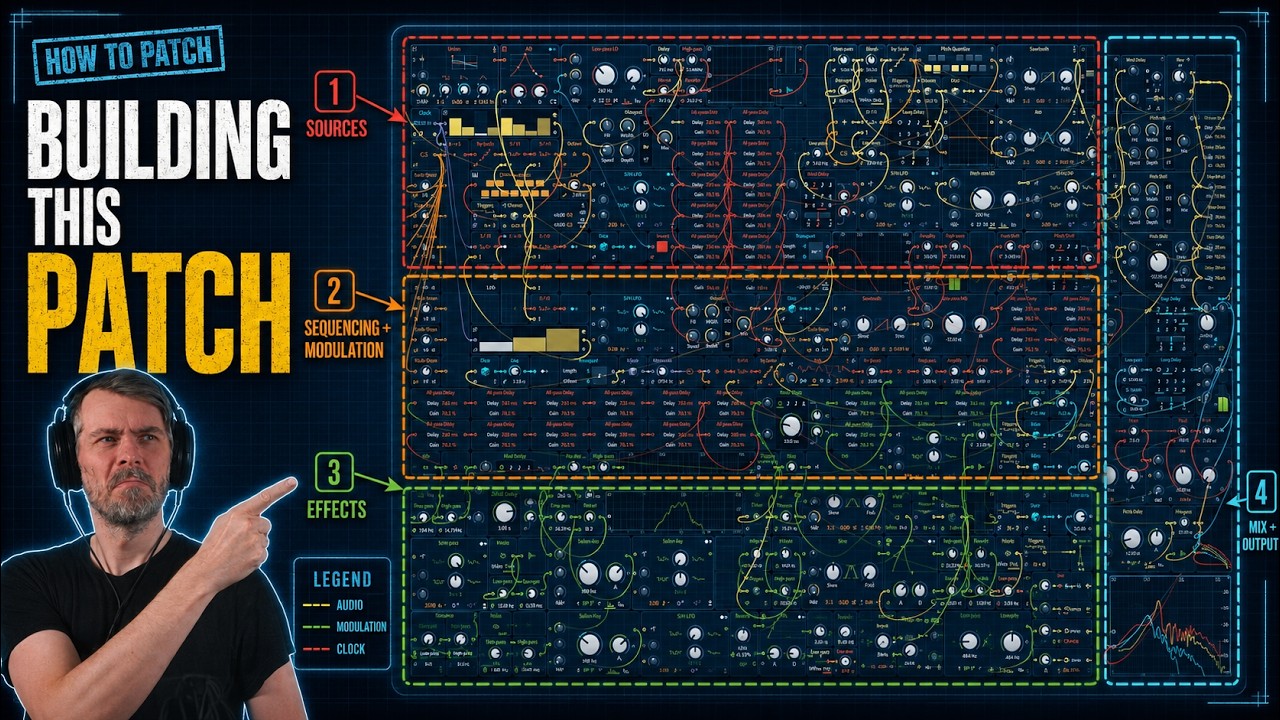
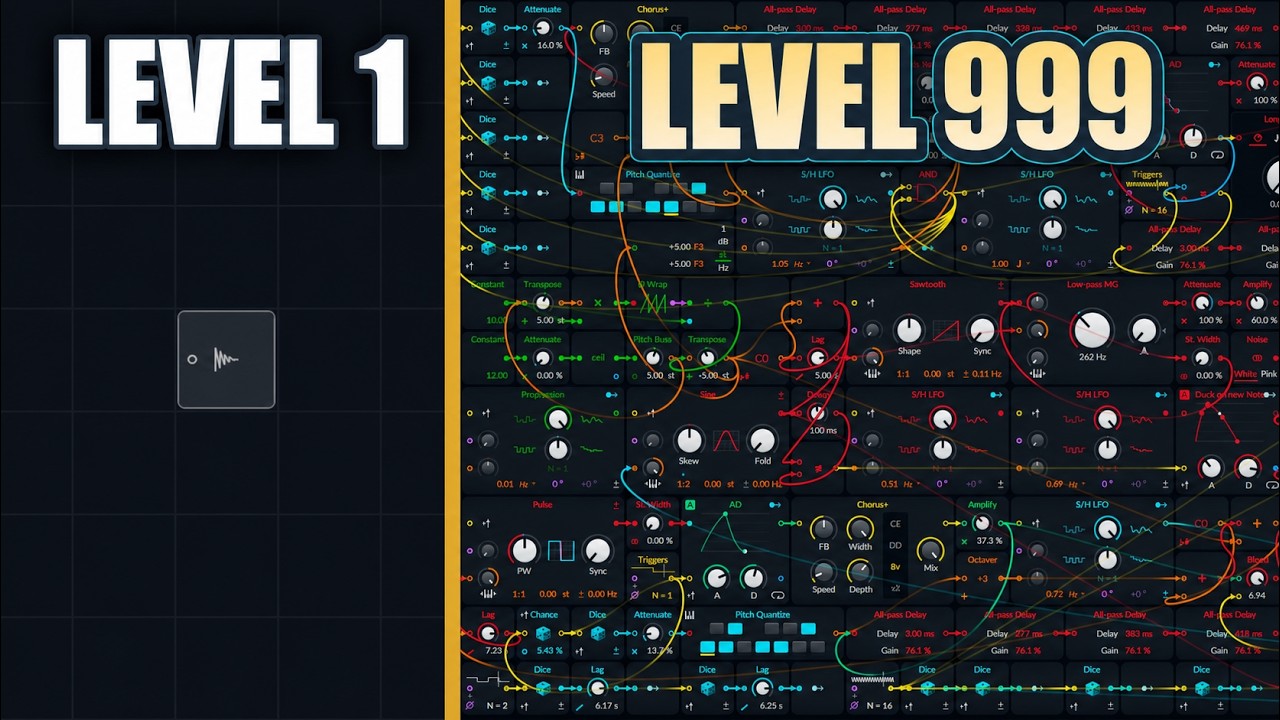
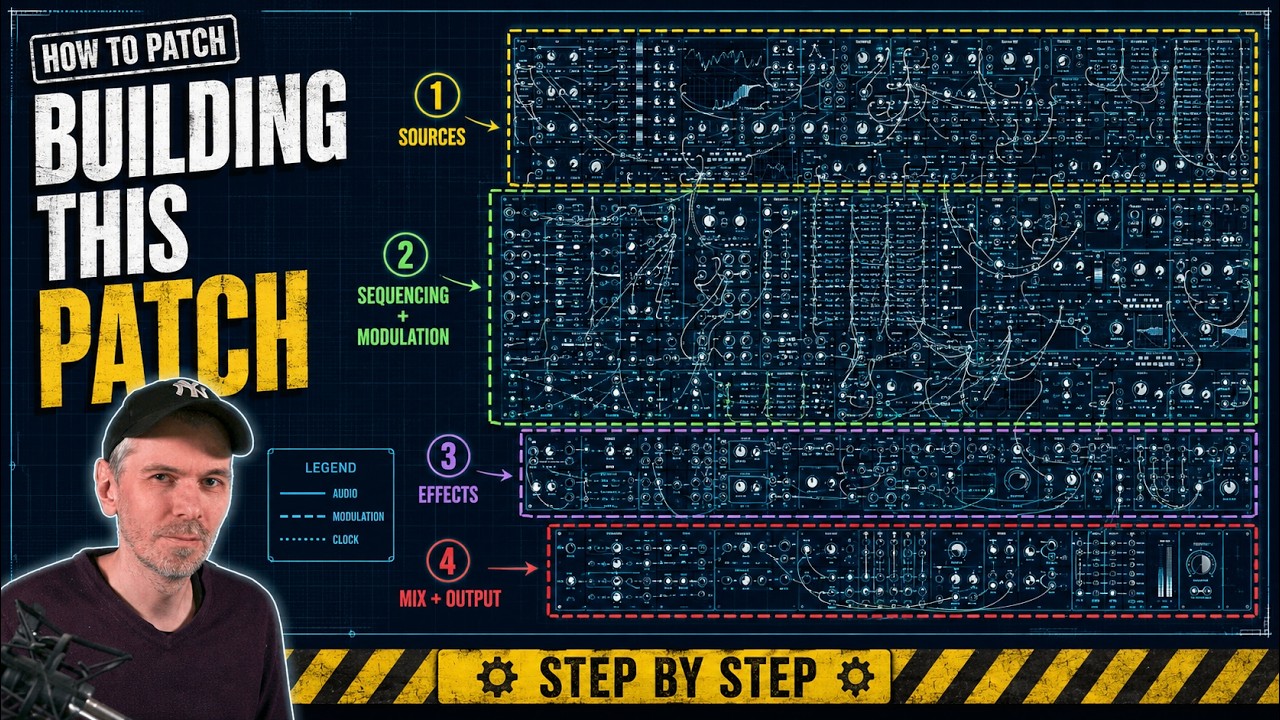
Bitwig Poly Grid: Building Rain Habitat from Scratch
Tutorial | Sep 27, 2026
Build Rain Habitat in Bitwig Poly Grid from a recorded noise sample, then add generative voices, bass, rain-drum textures, and layered all-pass spaces.
- You can watch the Video on Youtube
- Support me on Patreon if you like what you hear.
- Download the Rain Habitat Poly Grid preset.
Quick Answer #
- Patch type: A self-running Poly Grid soundscape in E-flat minor, built from scratch in Bitwig Studio 6.1.1.
- Starting source: A noise and Polarity Resonator sound is recorded and loaded into a Grid Sampler. Random playback and pitch control turn it into the first sustained layer.
- Main systems: Quantized pitch movement, clock-divided events, additional synthesized voices, a slower bass part, noise and wind textures, and a rain-drum-like sound.
- Spatial design: Several custom diffusion chains use All-pass Delay modules, pitch shifting, chorus, and modulation rather than one ready-made reverb preset.
- Result: The finished Rain Habitat patch produces long sci-fi pads, warm bass, and occasional raindrop-like hits. Listen to the finished performance.
Listen to the Finished Soundscape #
The related Polarity Music Only performance is It's Okay to Let Go for a Minute. The exact Rain Habitat preset file is available from the public polarity-music-tools repository.
Build Overview #
Rain Habitat begins with a recorded noise and resonator sound. Robert loads it into a Sampler inside Poly Grid, adjusts its root and playback behavior, and sets the patch in E-flat minor so he can combine renders with other Grid pieces. The first sustained voice grows through random playback, pitch shifting, and custom reverb chains built from All-pass Delay modules.
The patch then expands beyond that sample. Random notes gain a more structured sequence; clock division changes how quickly related parts move. Noise becomes a wind layer, and other pitched voices are tested and revised when they feel too busy. Much later, Robert adds a slower bass part, a rain-drum-like sound, long resonant spaces, and sine partials. He finishes by checking the dense patch's CPU load and listening to its overall balance.
This is a nearly three-hour exploratory build. It shows the decisions, detours, and listening checks that connect an initial source to a full generative soundscape, including choices that are changed or removed along the way.
Patch Decisions #
- A noise and Polarity Resonator sound is recorded first, then loaded into the Grid Sampler as the initial source.
- The Sampler starts with a transport-linked trigger and an Amp for level control. Root adjustment places the recorded pitch in the chosen E-flat-minor context.
- Spectral and random playback modes, looping, and occasional reverse motion are tried while the first pad takes shape.
- Chains of All-pass Delay modules build diffusion directly in the patch. Pitch shifting before and between these chains layers darker tones beneath the brighter source.
- Random pitch values are quantized; root, fourth, fifth, and later minor-second relationships are tested against the evolving texture.
- A more structured sequence and clock-divided triggers give related parts different rates of change without making every event equally random.
- Noise is shaped into a slow wind layer. Another pitched voice is revised when the result becomes too busy.
- A slower bass voice arrives well into the session, with note choices, filtering, mono low end, and glide adjusted by ear.
- Noise and filtering produce a rain-drum-like hit. Later resonant and all-pass spaces extend the small events into the wider soundscape.
- Near the end, Robert removes some comb filters while checking CPU load, then revisits the bass, drops, and final level by listening.
Interesting Moments #
- 00:00:00 - Starting a new Grid build
- 00:02:46 - Loading the noise/resonator recording into the Grid Sampler
- 00:07:53 - Building the first all-pass reverb
- 00:15:54 - Pitch shifting between reverb layers
- 00:28:49 - Giving random notes a sequence
- 00:45:03 - Adding noise and wind texture
- 00:58:31 - Rethinking the first pad sound
- 01:16:18 - Trying another pitched voice
- 01:46:36 - Building the slower bass part
- 02:15:00 - Shaping a rain-drum-like sound
- 02:22:45 - Filling the space with a long reverb
- 02:35:11 - Adding sine partials
- 02:48:09 - Checking CPU and removing comb filters
- 02:53:45 - Final pitch and balance check
What This Build Is Useful For #
For Grid learners, the reusable ideas are source recording, sampler playback control, quantized but changing pitch, clock-divided event rates, layered all-pass diffusion, and balancing a slow bass against small percussive details. The near-continuous session also shows how Robert evaluates a sound that feels too busy, revises parts, and manages a very large patch toward the end.
Transcript #
This is the transcript of the video. The text was generated automatically and may contain small mistakes. The timestamps jump to the matching part of the video.
Click to expand transcript
[00:00:00] So another grid, I haven't built the grid in almost, I don't know, two weeks, three weeks or so, so I maybe should create something new.
[00:00:09] Normally when I create these grids sometimes, not all the time, I just listen to some other music.
[00:00:17] So I build these grids basically without listening to the grid itself.
[00:00:21] I just build stuff and then listen to something else in the background.
[00:00:27] And then at some point I switch of course and listen to what I just created.
[00:00:31] And yeah, but when I record these videos, I can't do that.
[00:00:35] So I have to talk about what I do.
[00:00:39] So yeah, maybe for today I start by creating some samples.
[00:00:48] Maybe I haven't done a grid actually on my channel with a sampler in a few years.
[00:00:59] Maybe I use my polarity resonator here.
[00:01:06] And I create first some sounds with noise.
[00:01:15] I feel like that.
[00:01:19] Let's go to, let's stay on C.
[00:01:27] Yeah, that's too low.
[00:01:57] And then I just record that, my recorder.
[00:02:27] [music]
[00:02:46] And then I just put it into the sampler I guess.
[00:02:56] I feel like that.
[00:02:59] [music]
[00:03:05] And most grids and just pads, maybe chord.
[00:03:13] It's one shot.
[00:03:15] Yeah, why not?
[00:03:17] Maybe put this in here.
[00:03:21] And then we delete this.
[00:03:24] We have something to work with.
[00:03:26] So that's the idea.
[00:03:29] We disconnect that.
[00:03:32] Use an amplifier here to control the volume.
[00:03:38] And we use maybe, what's the name, playback.
[00:03:43] Transport playing.
[00:03:45] So this one starts here, this one.
[00:03:48] It's already on C3 because I recorded this also on C3.
[00:03:52] I'll need to correct that.
[00:03:59] Maybe we use here, not a pitch, we use a root module.
[00:04:04] Go in there.
[00:04:06] We disable that.
[00:04:08] And then we can go to EP minor.
[00:04:12] That's not really important.
[00:04:16] But I choose to use E flat minor.
[00:04:23] Because all my other grids also use E flat minor.
[00:04:26] And I can just mix and match them sometimes with the renderings.
[00:04:32] It's quite fun when you have all the tracks in the same scale.
[00:04:38] But yeah, you don't need to do that.
[00:04:41] It's just my stick.
[00:04:46] So we have that.
[00:04:49] Maybe we go into certain loop length.
[00:04:56] And we get the sound.
[00:05:06] So we can go to spectral here.
[00:05:08] Let's see what we get out of those different play modes here.
[00:05:30] Random, not the way, I choose random here.
[00:05:52] And we need to loop it, probably.
[00:05:59] Octoskey.
[00:06:25] I don't know how it sounds later on when we have some kind of reverb on that.
[00:06:41] Stick with 12, just one octave.
[00:06:48] And your also bipolar also can sometimes play backwards.
[00:06:57] And what's that here, that's the format processing.
[00:07:26] Yeah, I think start with that.
[00:07:41] And then just put the reverb on that and see how this sounds.
[00:07:47] And we actually stop this on every one I switch the modes.
[00:07:53] Let's come up with the shimmery rub, this one.
[00:08:01] Maybe 12 stages.
[00:08:06] And we end on, it's actually, it's a drone so it can be long.
[00:08:12] Maybe 300 milliseconds or so.
[00:08:18] Start with 12 here.
[00:08:22] Let's see how this works.
[00:08:23] I put this here on my different screen, on my other screen.
[00:08:27] So we need to use an alpass.
[00:08:33] Go in here.
[00:08:36] And we start with 12.
[00:08:41] We have, I should actually create some kind of export on the website.
[00:08:54] So I can import just a grid preset, that should be fun.
[00:09:15] 16, this is 7, 8, 10.
[00:09:40] And the last one, 300.
[00:09:54] Okay, let's see how this sounds.
[00:10:13] So this is the first reverb.
[00:10:29] Someone commented, I think in one of my videos, all that just for one pad sound.
[00:10:37] It's quite funny.
[00:10:38] But the thing is, if you create a pad sound, you usually don't see all of this.
[00:10:44] But you have a reverb already in place in the door or inside of the synthesizer.
[00:10:49] You don't need to create this.
[00:10:50] But here in the grid, I create everything from scratch.
[00:10:54] That's the point.
[00:10:55] So we can see all the complexity that's normally hidden away.
[00:11:02] Let's use another one here.
[00:11:25] It has a different feel.
[00:11:27] It's very a feel, or what's the name?
[00:11:32] Very moody.
[00:11:50] Maybe you should shift an octave.
[00:11:53] Let's see how this sounds.
[00:12:14] I think the other one was better.
[00:12:25] And let's switch this down to C2 so it's pitched up, hopefully.
[00:12:38] We pitch it back down with this one.
[00:12:47] Slow grain rate.
[00:12:52] We have now here this what we get here.
[00:12:56] The dry signal and also the wet signal from the pitch shifter, which pitch shifts everything down by 12 semitones.
[00:13:07] You can maybe do this again.
[00:13:30] But after the...
[00:13:45] We get this here.
[00:13:48] Maybe do another all pass.
[00:14:17] Something like that.
[00:14:26] Maybe the umeter here.
[00:14:28] The umeter there.
[00:14:39] And I need here some what's that, two, four, six, six stage.
[00:14:48] Start is three milliseconds and is 200 milliseconds maybe.
[00:15:00] We get very diffuse.
[00:15:04] And we start here with three milliseconds.
[00:15:08] And then we go into that, which is a very specific number.
[00:15:35] And 200.
[00:15:54] This is actually my favorite trick right now using this pitch shifter in front of the reverb and slowly building layer below layer.
[00:16:06] So I have this high pitched thing here, right, and then go through reverb.
[00:16:11] Also, this one is already pitched down.
[00:16:15] Then I take all the outputs, pitch it down even more.
[00:16:19] Make it a bit louder.
[00:16:21] Maybe it is a bit quieter.
[00:16:35] Yeah, and use another chorus.
[00:16:42] Maybe flanger.
[00:16:44] Flanger could be cool.
[00:16:47] Maybe in front.
[00:16:58] And then I move this over here like that.
[00:17:24] Okay, what about this was 20 or 25.
[00:17:55] Band knob.
[00:18:00] Speed knob.
[00:18:11] I hope this is in a scale.
[00:18:13] I hope this makes sense when I now play some notes to it.
[00:18:18] Let's try it out for a moment here.
[00:18:28] That was a quantizer.
[00:18:37] So in C, this is the root. This is the fourth. This is the fifth.
[00:18:45] Let's add the root note to it.
[00:18:56] Quantize it to the scale again.
[00:19:07] So we have random pitch, annuating going there.
[00:19:31] Amplify.
[00:19:43] That's that.
[00:19:54] Take a chance.
[00:20:05] And check it the same reverb here.
[00:20:32] And then we have a chorus.
[00:21:02] Maybe we add here the minor second to it.
[00:21:26] Okay, let's use another sign.
[00:21:29] This is for phase modulation here or phase distortion here.
[00:21:37] And every time we get a trigger.
[00:21:47] We randomize the ratio like that.
[00:21:57] And also the amount.
[00:22:27] Maybe I need also this reverb here additionally.
[00:22:49] Okay, I try to add low pass to this one here.
[00:23:18] Yeah, also want to modulate that.
[00:23:33] Okay, let's try it out.
[00:23:49] Okay, let's try it out.
[00:24:14] Nice.
[00:33:41] Okay, let's try it out.
[00:33:49] Okay, so now that we have this, here's a modulator out here, and then we use that for.
[00:34:04] Okay, so we have the same melody, more or less, but this one opens up here to satinulate,
[00:34:23] which makes the range bigger, which then ends up on different notes, or maybe you go to
[00:34:42] five, let's see how that sounds, it goes here after the feedback here, maybe.
[00:34:59] Okay, so now that we have this, here's a modulator out here, so let's try it out.
[00:35:15] Okay, and here I want to have a bit of modulation for the delay time.
[00:35:41] Okay, so now that we have the modulator out here, let's try it out.
[00:35:57] Okay, so now that we have the modulator out here, let's try it out.
[00:36:07] Okay, and then we want to re-trigger this whole thing, maybe do we have here transport?
[00:36:29] Go every 32 bars, maybe, get the trigger every 32 bars, so we re-trigger here the note generation
[00:36:45] here, and also this one, okay, so maybe we do this again, instead of this clock, you
[00:37:15] divide, use another clock divide, which slows this down even more, from here, every three
[00:37:23] steps, every five steps, so every three five steps, and use that to modulate this one here
[00:37:41] by four, maybe, and then this one gets out of rhythm pretty fast, so we use a clock quantizer,
[00:38:02] so it changes also the rhythm.
[00:38:18] Maybe this is too much here.
[00:38:38] Okay, so now that we have the modulator out here, let's try it out.
[00:38:59] Okay, we can extend this even more.
[00:39:25] Let's do for every step, for every step, we do a different decay time.
[00:39:52] Okay, for every step, skew.
[00:40:13] Okay, so we have this one here, okay, so we have this one here, okay, so we have this one here,
[00:40:43] okay, so we have this one here, okay, so we have this one here, okay, so we have this
[00:41:10] one here, okay, so we have this one here, okay, so we have this one here, okay, so we
[00:41:39] have this one here, okay, so we have this one here, okay, so we have this one here,
[00:42:05] okay, so we have this one here, okay, so we have this one here, okay, so we have this
[00:42:19] one here, okay, so we have this one here, okay, so we have this one here, okay, so we
[00:42:38] have this one here, okay, so we have this one here, okay, so we have this one here,
[00:43:01] okay, so we have this one here, okay, so we have this one here, okay, so we have this
[00:43:14] one here, okay, so we have this one here, okay, so we have this one here, okay, so
[00:43:34] we have this one here, okay, so we have this one here, okay, so we have this one here,
[00:43:51] okay, so we have this one here, okay, so we have this one here, okay, so we have this
[00:44:15] one here, okay, so we have this one here, okay, so we have this one here, okay, so we
[00:44:39] have this one here, okay, so we have this one here, okay, so we have this one here,
[00:45:06] okay, so we have this one here, okay, so we have this one here, okay, so we have this
[00:45:30] one here, okay, so we have this one here, okay, so we have this one here, okay, so we
[00:45:46] have this one here, okay, so we have this one here, okay, so we have this one here,
[00:46:05] okay, so instead of an LFO or a random LFO, I take this one here,
[00:46:30] okay, so we have this one here, okay, so we have this one here, okay, so we have this
[00:46:59] one here, okay, so we have this one here, okay, so we have this one here, okay, so
[00:47:23] we have this one here, okay, so we have this one here, okay, so we have this one here,
[00:47:48] okay, I don't like this empty stuff here, maybe I put all of that stuff in here, I don't
[00:48:15] like this, okay, so we have this one here, okay, so we have this one here, okay, so
[00:48:42] we have this one here, okay, so we have this one here, okay, so we have this one here,
[00:49:09] okay, so I have this one here, okay, so we have this one here, okay, so we have this
[00:49:34] one here, okay, so we have this one here, okay, so we have this one here, okay, so we
[00:49:59] change it also randomly, 32 bars are very slow, so it's not playing all the time, maybe
[00:50:29] short on maybe 24 bars, okay, so we have this one here, okay, so we have this one here,
[00:50:58] okay, so we have this one here, okay, so we have this one here, okay, so we have this
[00:51:16] one here, okay, so we have this one here, okay, so we have this one here, okay, so we
[00:51:41] have this one here, okay, so we have this one here, okay, so we have this one here,
[00:52:10] okay, so we have this one here, okay, so we have this one here, okay, so we have this
[00:52:26] one here, okay, so we have this one here, okay, so we have this one here, okay, so we
[00:52:52] have this one here, okay, so we have this one here, okay, so we have this one here,
[00:53:19] okay, okay, so we have this one here, okay, so we have this one here, okay, so we have
[00:53:37] this one here, okay, so we have this one here, okay, so we have this one here, okay, so
[00:54:01] yeah, this could be interesting on the whole thing, but adding now some kind of mod delay
[00:54:22] to everything, what's the name, Mixer, okay, so we have this one here, okay, so we have
[00:54:45] this one here, okay, so we have this one here, okay, so we have this one here, okay, so
[00:55:11] we have this one here, okay, so we have this one here, okay, so we have this one here,
[00:55:35] okay, so we have another output here, somewhere here, yeah, this one, okay, so when we add
[00:55:57] an amplifier here, we can mute it, okay, so instead of that here, use this here, it's
[00:56:23] kind of erosion, that's too much, okay, so we have this one here, okay, so we have
[00:56:51] this one here, okay, so we have this one here, okay, okay, so we have this one here, okay,
[00:57:17] so we have this one here, okay, so we have this one here, okay, so we have this one here,
[00:57:44] okay, so we have this one here, okay, so we have this one here, okay, so we have this
[00:57:57] one here, okay, so we have this one here, okay, so we have this one here, okay, so
[00:58:22] yeah, I think you did the pad sound in the beginning, it was not the greatest idea,
[00:58:36] okay, so let's see if I switch this here to pure, comes out of that, okay, so we have
[00:59:02] this one here, okay, so we have this one here, okay, so we have this one here, okay, so
[00:59:28] we have this one here, okay, so this one here, okay, so we have this one here, okay, so
[00:59:51] we have this one here, okay, so let's switch this here to pure, okay, so we have this one
[01:00:09] here, okay, so
[01:00:39] okay, so
[01:01:09] okay, so
[01:01:39] I need to have slight, slight, what's relations in there?
[01:02:09] okay, so
[01:02:39] maybe I'll use the second one,
[01:03:10] sounds more like a piano then,
[01:03:16] I need the dense delay,
[01:03:26] very diffuse but not that long, maybe 100,
[01:03:37] started to, maybe use, I don't know, 8,
[01:03:42] very diffusing,
[01:04:03] so
[01:04:33] ,
[01:05:03] ,
[01:05:34] yeah, also much like that,
[01:05:42] and we need the chorus in there,
[01:06:03] so
[01:06:34] let's use the same, same amount,
[01:07:03] ,
[01:07:33] ,
[01:08:03] ,
[01:08:10] random,
[01:08:14] bam,
[01:08:31] and we should quantize this,
[01:09:01] ,
[01:09:14] so
[01:09:31] ,
[01:09:40] maybe we should make this much longer here,
[01:10:01] okay,
[01:10:04] so let's start with 8 and start with maybe, I don't know, 60ms, end up on 500,
[01:10:31] four,
[01:10:37] eight, okay, let's start with 60ms,
[01:10:57] actually I'm really enjoying doing this here, because it completely
[01:11:02] throws me out of my day, I don't think about anything else,
[01:11:08] which is really relaxing,
[01:11:22] okay let's try that,
[01:11:52] ,
[01:12:05] so,
[01:12:22] ,
[01:12:52] ,
[01:12:59] and it's there,
[01:13:22] ,
[01:13:52] ,
[01:14:23] ah,
[01:14:35] maybe I need more,
[01:14:41] more reverb,
[01:14:53] hmm, and I don't really like it, to be honest, it's not what I envisioned,
[01:15:23] so,
[01:15:29] maybe I need a high-pass here,
[01:15:53] so,
[01:15:55] I leave it for now,
[01:16:05] okay, maybe I try another one,
[01:16:22] ,
[01:16:49] maybe I try something like that,
[01:17:20] and then I need different pitches,
[01:17:27] that, I again use sequencer,
[01:17:52] only if it's true they are,
[01:18:22] ,
[01:18:52] ,
[01:19:05] so,
[01:19:22] ,
[01:19:52] ,
[01:20:23] okay, that's better,
[01:20:53] okay,
[01:21:01] it's very sensible here in the beginning,
[01:21:15] this one here,
[01:21:22] so,
[01:21:33] okay, I want to have a different,
[01:21:50] bit of dispersion,
[01:22:20] ,
[01:22:31] so,
[01:22:51] okay, almost sounds like a piano without the body,
[01:22:57] let's see,
[01:23:01] if we can simulate something,
[01:23:07] ah, what do we need,
[01:23:37] ,
[01:24:08] and there's no EQ in the grid,
[01:24:37] ,
[01:24:52] this is the octave shift,
[01:25:07] ,
[01:25:37] ,
[01:26:07] so,
[01:26:14] too busy,
[01:26:37] ,
[01:26:44] so,
[01:27:08] ,
[01:27:37] ,
[01:28:07] ,
[01:28:37] ,
[01:28:52] yeah, yeah, blend this in and out,
[01:29:07] one bar,
[01:29:12] no, 30 bars,
[01:29:37] ,
[01:29:46] wait a minute,
[01:30:07] ,
[01:30:37] ,
[01:31:08] ,
[01:31:38] okay, it's getting a bit out of hand,
[01:32:07] ,
[01:32:37] ,
[01:33:07] ,
[01:33:20] yeah, we need to move this here a little bit,
[01:33:38] over three bars,
[01:34:07] ,
[01:34:38] ,
[01:34:52] ah, I'm not a big fan,
[01:35:07] ,
[01:35:14] maybe,
[01:35:20] maybe instead of this,
[01:35:37] ,
[01:36:07] ,
[01:36:37] ,
[01:37:07] it's more, more sparse,
[01:37:37] yeah, that's better,
[01:37:46] okay, so maybe I save this first, what's the date,
[01:38:06] seven, 27,
[01:38:34] okay, so some sound effects we need,
[01:39:04] ,
[01:39:34] ,
[01:40:04] ,
[01:40:35] let's see how this sounds,
[01:41:04] ,
[01:41:35] ,
[01:42:04] ,
[01:42:34] ,
[01:42:41] ,
[01:43:04] ,,
[01:43:11] we're you, you, you,
[01:43:34] ,,,
[01:44:04] ,,
[01:44:11] yes,
[01:44:34] ,,,,,
[01:45:04] ,,,,
[01:45:34] ,,,,,,,,,,,,,,,,,,,,,,,,,,
[01:45:59] ,,,,,,,,,,,,,,,,,,,
[01:46:28] okay, I need to need to make a break for a minute,
[01:46:33] so let's add some bass,
[01:46:39] I think I do the same trick here, the merge,
[01:46:51] maybe four bass notes,
[01:46:56] one stays on zero, which is the root,
[01:47:01] I'm going to copy just this here,
[01:47:26] ,
[01:47:35] zero, maybe minus one,
[01:47:56] ,
[01:48:26] ,,,
[01:48:31] or maybe you don't use an ADSR at all,
[01:48:56] ,,,,,
[01:49:19] let's have a splitter here,
[01:49:27] splitter,,,,,,,,,
[01:49:44] make it one over here,
[01:50:12] one at a clock-to-byte counter,
[01:50:41] one is too fast,
[01:50:46] this are every four bars a new note,
[01:51:08] yeah we can open up the filter,
[01:51:13] so C is basically exactly the note we are playing,
[01:51:30] which is too low, so you go one octave higher, which is basically the first
[01:51:36] partial,
[01:52:06] this is the modulation here we get,
[01:52:19] this would open up the filter,
[01:52:23] additionally to the position,
[01:52:27] we use a band,
[01:52:36] one at a clock-to-byte counter,
[02:48:08] one at a clock-to-byte counter,
[02:48:12] I feel a lot of comp filters in there. I kill some.
[02:48:18] Yeah, it goes down fast.
[02:48:42] [Music]
[02:48:46] [Music]
[02:48:50] [Music]
[02:48:54] [Music]
[02:48:58] [Music]
[02:49:02] If you have a smaller CPU, sorry.
[02:49:06] [Music]
[02:49:10] [MUSIC PLAYING]
[02:49:40] [MUSIC PLAYING]
[02:50:10] [MUSIC PLAYING]
[02:50:13] Ay, ay, ay, ay, ay.
[02:50:41] Now, when I save the patch and reload it,
[02:50:44] it's probably a little bit better.
[02:50:47] What a monster.
[02:51:10] [MUSIC PLAYING]
[02:51:40] [MUSIC PLAYING]
[02:52:10] [MUSIC PLAYING]
[02:52:13] That's it.
[02:52:20] It's happening when I close this.
[02:52:35] Oh, yeah, the CVO goes down.
[02:52:37] I just close.
[02:52:41] [MUSIC PLAYING]
[02:53:07] [MUSIC PLAYING]
[02:53:37] [MUSIC PLAYING]
[02:54:07] Let's go to minus 12.
[02:54:08] I don't know what the other tracks are on my channel.
[02:54:11] Minus 12 sounds right, probably less.
[02:54:28] That's 14.
[02:54:37] [MUSIC PLAYING]
[02:54:40] I need to listen to it on my monitors or my speakers,
[02:55:02] just to have an idea, a rough idea.
[02:55:06] Probably the drops are too loud.
[02:55:10] I kind of like it.
[02:55:36] [MUSIC PLAYING]
[02:55:39] Anyway, so that's it for this video.
[02:55:46] I tried to record the video now, which should be two hours
[02:55:51] long, at least.
[02:55:54] And then I upload this stuff to YouTube.
[02:55:57] Thanks for watching.