Diode
Bitwig Platform
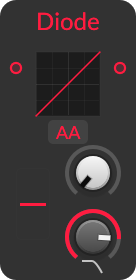
A diode-circuit clipper with Drive, bipolar Bias, high-frequency damping, and a high-order processing mode.
What it does
Diode models unequal upward and downward conduction. Drive pushes the signal into that nonlinear response, Bias changes the balance of the two directions, and Cutoff/LP damps the circuit so sharp clipped edges can be softened.
Controls and ports
| Control | Label | Official description |
|---|---|---|
bias |
Bias | Offset for tilting the signal up or down |
Practical uses
- Use centered Bias for clipping, then offset it to introduce even harmonics and asymmetry.
- Lower the internal Cutoff after strong Drive to tame newly generated highs.
- Process control signals as well as audio when you want a voltage-like nonlinear bend.
Things to know
- Bias changes the transfer curve itself rather than merely adding a DC offset before a symmetric clipper.
- Asymmetry can create DC and even harmonics; monitor or high-pass the result when necessary.
- HQ switches to a separate antialiased diode implementation, not just oversampling of the same direct equation.
- The cheap drum-diode candidate is unrelated to the complete Grid wrapper.
Technical details
A high-confidence Nitro implementation candidate supports the technical summary, but the visible-module mapping remains inferred.
The matching grid/shaper/diode_clipper component exposes exactly x, Drive, LP, Bias, HQ, and Out. It converts Bias magnitude and sign into separate upward/downward factors, updates each diode model only when Bias or LP changes, and applies fixed polarity/gain compensation around processing. HQ uses DiodeClipperAA, while the direct path uses DiodeClipper; both contain smoothed low-pass and bias-dependent coefficient state. The wrapper runs four sub-samples and maintains distinct state for the two quality paths.
| Nitro port | Type |
|---|---|
x |
InputAudioPortType |
drive |
InputAudioPortType |
lp |
InputAudioPortType |
bias |
InputAudioPortType |
HQ |
InputValuePortType |
out |
OutputAudioPortType |
Open questions
- Measure the static transfer for Bias and Drive, including zero crossing, DC, even/odd harmonics, and gain compensation.
- Recover LP frequency mapping and compare direct versus HQ magnitude, phase, latency, and aliasing.
- Confirm wrapper binding, stereo independence, smoothing, initialization, and extreme-setting stability.
Version and sources
Checked against Bitwig Studio 6.0.6. This page combines Bitwig's module metadata, the existing Grid course and guides, and Nitro analysis where the mapping is strong enough to support a technical statement.
Related material
Return to Bitwig Grid Modules or the Grid Modules course lesson.
Also matches: Bitwig Diode module, Bitwig Grid Diode, Diode Grid module