Saturator
Bitwig Platform
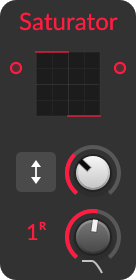
A detailed level-domain transfer shaper with separate quiet/loud knees and bipolar skew controls.
What it does
Saturator designs a static input-to-output curve in decibels. Loud controls bend or fold signal above an upper threshold, Quiet controls reshape low-level content near silence, and Skew lets positive and negative waveform halves use different high-level behavior.
Controls and ports
Signal In feeds a graphical transfer curve. Quiet Threshold, Ratio, and Knee shape low levels; Loud Threshold, Ratio, and Knee shape high levels; Skew Threshold, Ratio, and Knee offset the two polarities; visualization and auxiliary outputs describe the active curve and level regions.
Practical uses
- Use the Loud section for soft clipping, saturation, or folding while watching the transfer display.
- Use the Quiet section as an expander/gate-like shaper for noise and tails.
- Skew positive and negative halves differently to introduce even harmonics or asymmetric punch.
Things to know
- This is a transfer-curve designer, not one fixed analog saturation model.
- The Quiet section can make near-zero material quieter or louder and therefore affects noise and ambience strongly.
- Bipolar skew can create DC and even harmonics.
- The recovered body calculates the level-dependent gain curve; visible audio multiplication and display wiring may be handled by its wrapper.
Technical details
A high-confidence Nitro implementation candidate supports the technical summary, but the visible-module mapping remains inferred.
The exact-name grid/shaper/saturator body converts |input| to dB with a floor at -60 dB. It calculates separate quadratic knees above highThreshold and below lowThreshold, applies high/low ratios, and converts the resulting dB change back with 10^(dbOut/20). Input sign selects skewed high threshold, ratio, and knee values. Auxiliary outputs expose above/below amounts and smoothed negative/positive display extents. Because the body outputs a positive gain factor, the surrounding visible module is expected to apply that factor to the signed input.
| Nitro port | Type |
|---|---|
in |
InputAudioPortType |
lowThreshold |
InputAudioPortType |
lowRatio |
InputAudioPortType |
lowKnee |
InputAudioPortType |
highThreshold |
InputAudioPortType |
highRatio |
InputAudioPortType |
highKnee |
InputAudioPortType |
skewThreshold |
InputAudioPortType |
skewRatio |
InputAudioPortType |
skewKnee |
InputAudioPortType |
out |
OutputAudioPortType |
Open questions
- Confirm wrapper multiplication and map every visible Loud, Quiet, and Skew control to the recovered ports.
- Measure complete transfer curves, knee definitions, folding ranges, gain compensation, DC, and output bounds.
- Test stereo linking, smoothing, latency, initialization, and fast audio-rate modulation.
Version and sources
Checked against Bitwig Studio 6.0.6. This page combines Bitwig's module metadata, the existing Grid course and guides, and Nitro analysis where the mapping is strong enough to support a technical statement.
Related material
- Grid Modules course reference
- Bitwig Saturator Device - Distortion, Wave Shaping, Harmonics and Saturation
Return to Bitwig Grid Modules or the Grid Modules course lesson.
Also matches: Bitwig Saturator module, Bitwig Grid Saturator, Saturator Grid module