Shred
Bitwig Platform
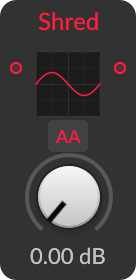
A high-order nonlinear folder with several internal zero crossings for subtle cancellation or chaotic artifact-like tones.
What it does
Shred applies a dense polynomial/rational folding curve only within a finite input window. Different driven regions alternate polarity and amplitude, while values beyond the outer boundaries collapse toward zero, producing cancellations, narrow lobes, and abrupt spectral changes.
Controls and ports
Signal In is multiplied by Drive, HQ selects direct or second-order antiderivative processing, and Signal Out returns the complex folded result.
Practical uses
- Move Drive slowly to locate narrow cancellation and emphasis zones.
- Use it on simple waveforms for complex spectra without a separate modulation source.
- Blend it in parallel for unstable texture while preserving a dry tonal anchor.
Things to know
- More Drive is not monotonically louder because the transfer has many sign changes and zeros.
- The candidate curve is exactly zero outside ±1 before its large normalization factor.
- Small parameter changes can move samples between lobes and cause large timbral changes.
- HQ reduces aliasing but cannot make a highly folded discontinuous spectrum band-limited.
Technical details
A high-confidence Nitro implementation candidate supports the technical summary, but the visible-module mapping remains inferred.
The inferred grid/shaper/drunk_clip candidate implements DrunkFold: inside -1<x<1 it evaluates a high-order odd rational polynomial with zeros at 0, ±0.25, ±0.5, ±0.75, and ±1; outside that interval it returns zero. The result is scaled by 498. Analytic first and second antiderivatives support direct and second-order ADAA evaluation per channel. This multi-lobed cancellation pattern strongly matches Shred's description.
| Nitro port | Type |
|---|---|
x |
InputAudioPortType |
drive |
InputAudioPortType |
HQ |
InputValuePortType |
out |
OutputAudioPortType |
Open questions
- Confirm the Shred binding with a dense static sweep and locate every zero, extremum, and boundary value.
- Measure Drive mapping, output normalization, HQ alias suppression, latency, boundary continuity, and transient state.
- Test stereo independence, automation smoothing, dry cancellation, and numerical stability near ±1.
Version and sources
Checked against Bitwig Studio 6.0.6. This page combines Bitwig's module metadata, the existing Grid course and guides, and Nitro analysis where the mapping is strong enough to support a technical statement.
Related material
Return to Bitwig Grid Modules or the Grid Modules course lesson.
Also matches: Bitwig Shred module, Bitwig Grid Shred, Shred Grid module