Howl
Bitwig Platform
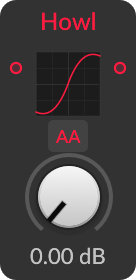
A damped sine wavefolder that brings successive input regions into alternating, loud focus.
What it does
Howl drives the signal through a sine-based folder, then reduces the amplitude of increasingly distant folds with a reciprocal window. The result cycles through emphasized regions while remaining bounded as Drive grows.
Controls and ports
Signal In is multiplied by Drive, HQ selects the high-order filtered/antiderivative path, and Signal Out returns the windowed sine-fold result.
Practical uses
- Sweep Drive on a sustained tone to move different waveform regions into focus.
- Use it for aggressive vocal, bass, and percussion coloration with a bounded output.
- Mix it in parallel when the full fold pattern removes too much of the original fundamental.
Things to know
- Its static curve changes direction repeatedly because of the sine term.
- The reciprocal window makes folds farther from zero quieter rather than equally loud.
- The HQ path also applies four 18 kHz one-pole stages to the sine and window components.
- Different Drive values can cancel or restore the fundamental non-monotonically.
Technical details
A high-confidence Nitro implementation candidate supports the technical summary, but the visible-module mapping remains inferred.
The exact grid/shaper/howl direct equation is out = sin((pi/2)*drive*x)/(1+|drive*x|). HQ evaluates the sine and reciprocal window with independent second-order ADAA objects, initializes their states on first use, low-passes each component through four stages at a nominal 18 kHz in the 4x domain, and multiplies them. This establishes a damped periodic folder with extra high-frequency control in HQ mode.
| Nitro port | Type |
|---|---|
x |
InputAudioPortType |
drive |
InputAudioPortType |
HQ |
InputValuePortType |
out |
OutputAudioPortType |
Open questions
- Measure the HQ low-pass calibration, latency, magnitude change, and alias rejection across sample rates.
- Map visible Drive to fold count and quantify harmonic/fundamental cancellations.
- Confirm the apparently hardwired
likelyHQbranch, UI switch behavior, stereo independence, and reset transient.
Version and sources
Checked against Bitwig Studio 6.0.6. This page combines Bitwig's module metadata, the existing Grid course and guides, and Nitro analysis where the mapping is strong enough to support a technical statement.
Related material
Return to Bitwig Grid Modules or the Grid Modules course lesson.
Also matches: Bitwig Howl module, Bitwig Grid Howl, Howl Grid module