Heat
Bitwig Platform
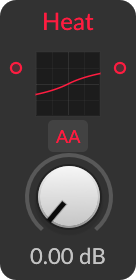
An S-shaped character clipper that begins gently and becomes strongly nonlinear under Drive.
What it does
Heat applies a smooth odd-symmetric curve whose center remains responsive while larger values bend, oscillate slightly, and compress. Increasing Drive moves more of the waveform into the stronger outer curvature.
Controls and ports
Signal In is multiplied by Drive, HQ selects direct or antiderivative processing, and Signal Out returns the S-curve-shaped result.
Practical uses
- Use low Drive for subtle thickening and high Drive for assertive clipping.
- Apply it before a filter to generate harmonics that can then be sculpted.
- Level-match when choosing between Heat and Push because their gain and outer curves differ.
Things to know
- S-shaped refers to the transfer curve, not a frequency response.
- The curve is nonlinear around progressively larger magnitudes rather than a fixed hard threshold.
- HQ uses first-order antiderivative evaluation of the same transfer.
- The internal
s_clipname and curve are a strong semantic match, but live transfer measurement remains desirable.
Technical details
A high-confidence Nitro implementation candidate supports the technical summary, but the visible-module mapping remains inferred.
The inferred grid/shaper/s_clip body evaluates a symmetric transfer based on sin(x)/(1+|x|) and scales the result by 0.5 after applying Drive. Its accompanying first and second antiderivatives are explicitly implemented for ADAA. HQ selects calcAA1; direct mode evaluates the transfer directly, with independent double-precision state for left and right channels.
| Nitro port | Type |
|---|---|
x |
InputAudioPortType |
drive |
InputAudioPortType |
HQ |
InputValuePortType |
out |
OutputAudioPortType |
Open questions
- Measure the visible Heat curve against
s_clip, including small-signal gain, extrema, and output bound. - Quantify HQ aliasing, phase, latency, transient response, CPU, and automated Drive behavior.
- Confirm wrapper binding, stereo independence, and any hidden gain normalization.
Version and sources
Checked against Bitwig Studio 6.0.6. This page combines Bitwig's module metadata, the existing Grid course and guides, and Nitro analysis where the mapping is strong enough to support a technical statement.
Related material
Return to Bitwig Grid Modules or the Grid Modules course lesson.
Also matches: Bitwig Heat module, Bitwig Grid Heat, Heat Grid module