Distortion
Bitwig Platform
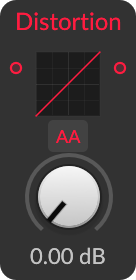
A one-control symmetric soft clipper with direct and antiderivative-antialiased processing modes.
What it does
Distortion multiplies the input by Amount and bends it progressively toward a bounded output instead of cutting it off abruptly. Low levels remain close to linear; higher levels compress and generate mostly odd harmonics for a centered symmetric waveform.
Controls and ports
| Control | Label | Official description |
|---|---|---|
amount |
Amount | Amount of gain applied |
Practical uses
- Add moderate Amount to thicken basses, drums, and oscillators without a hard edge.
- Level-match after the module to separate harmonic change from simple loudness.
- Enable anti-aliasing for exposed high-frequency material; compare it off when lower CPU or a rougher sound is preferable.
Things to know
- Amount is pre-shaper gain, so it changes how much of the nonlinear curve is visited.
- The direct path uses a fast tanh approximation rather than an exact analog circuit model.
- Soft clipping still aliases when it creates harmonics above Nyquist; the HQ path reduces rather than abolishes this.
- A symmetric centered curve mainly creates odd harmonics, but asymmetric input produces a different spectrum.
Technical details
A high-confidence Nitro implementation candidate supports the technical summary, but the visible-module mapping remains inferred.
The exact grid/shaper/distortion body computes y = drive*x for four sub-samples. With HQ off it evaluates a seventh-order tanh approximation. With HQ on it passes the same transfer through an antiderivative-antialiasing softclip2 operator whose state is reset at start. No automatic output-gain compensation is present in the recovered body.
| Nitro port | Type |
|---|---|
x |
InputAudioPortType |
drive |
InputAudioPortType |
HQ |
InputValuePortType |
out |
OutputAudioPortType |
Open questions
- Recover or measure the exact direct tanh approximation and HQ transfer at large inputs.
- Quantify alias rejection, latency, transient behavior, and CPU cost with HQ on and off.
- Confirm visible Amount mapping, stereo independence, state reset, and parameter smoothing.
Version and sources
Checked against Bitwig Studio 6.0.6. This page combines Bitwig's module metadata, the existing Grid course and guides, and Nitro analysis where the mapping is strong enough to support a technical statement.
Related material
Return to Bitwig Grid Modules or the Grid Modules course lesson.
Also matches: Bitwig Distortion module, Bitwig Grid Distortion, Distortion Grid module