All-pass
Bitwig Platform
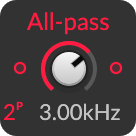
A magnitude-preserving filter that rotates phase around a selected frequency, with adjustable slope for stronger phase displacement.
What it does
All-pass passes the full spectrum at approximately unchanged magnitude but delays different frequencies by different amounts. Its selected Frequency is the point of 180-degree phase rotation for a one-pole stage; increasing slope compounds the phase shift without turning it into a conventional amplitude filter by itself.
Controls and ports
Audio In enters the phase filter, Frequency positions the rotation, Slope/Pole count changes how many phase turns are applied, and Audio Out supplies the phase-shifted signal. The module's effect becomes visible in magnitude when mixed with a dry or differently shifted copy.
Practical uses
- Adjust phase around a kick or bass fundamental before combining signals that partly cancel.
- Mix the output with dry, inverted, or differently shifted paths to construct notches, peaks, low-pass, high-pass, and custom shapes.
- Modulate Frequency for phaser-like motion or cascade stages for denser phase rotation.
Things to know
- An all-pass changes phase and group delay even when a spectrum analyzer shows a flat magnitude response.
- The audible result can be subtle in isolation and dramatic when signals are summed because phase differences become cancellation or reinforcement.
- Slope changes phase complexity; it should not attenuate a frequency band by itself in the ideal linear case.
- The recovered Nitro candidate is one underlying pole only; the visible adjustable-slope wrapper or cascade remains outside that body.
Technical details
A medium-confidence Nitro implementation candidate supports the technical summary, but the visible-module mapping remains inferred.
The recovered filter/allpass core is a first-order all-pass. For frequency f and sample rate Fs, it calculates g = tan(pi*f/Fs) and a = (g-1)/(g+1), then evaluates y[n] = a*x[n] + x[n-1] - a*y[n-1]. This has unity ideal magnitude and a 180-degree phase shift at the selected frequency under the module's convention. Because this body exposes no pole-count input, the visible Slope control is likely implemented by a surrounding cascade or wrapper that has not been recovered; that boundary is why the mapping is medium rather than high confidence.
| Nitro port | Type |
|---|---|
in |
InputAudioPortType |
freq |
InputAudioPortType |
out |
OutputAudioPortType |
Open questions
- Measure every Slope setting to determine stage count, phase rotation, gain error, group delay, and parameter smoothing.
- Confirm the exact visible Frequency calibration and wrapper relationship to the one-pole Nitro body.
- Test automation, stereo lanes, initialization, latency, extreme frequencies, and cancellation accuracy against a dry path.
Version and sources
Checked against Bitwig Studio 6.0.6. This page combines Bitwig's module metadata, the existing Grid course and guides, and Nitro analysis where the mapping is strong enough to support a technical statement.
Related material
Return to Bitwig Grid Modules or the Grid Modules course lesson.
Also matches: Bitwig All-pass module, All-pass Grid module, Bitwig Grid All-pass