High-pass
Bitwig Platform
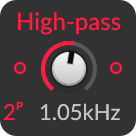
A clean high-pass built from one to six cascaded one-pole stages, with selectable slope and no resonance control.
What it does
High-pass removes slow movement and frequencies below Cutoff. Slope selects how many one-pole high-pass stages are cascaded, ranging from gentle bass reduction to a much steeper transition.
Controls and ports
Audio In is processed by Cutoff and Slope/Pole count; Audio Out returns the high-passed signal. The module is intentionally simpler than resonant multimode filters and does not expose Resonance or Drive.
Practical uses
- Remove DC, rumble, or low-frequency modulation from audio and control signals.
- Use a gentle slope for broad tonal cleanup and more poles for stronger separation.
- Place it inside feedback paths to prevent low-frequency buildup while leaving upper detail active.
Things to know
- Cascading poles steepens the magnitude response and adds phase rotation around Cutoff.
- The implementation compensates Cutoff by
1/sqrt(poles)before cascading, so the displayed corner is not simply the raw coefficient of every stage. - There is no resonance or nonlinear saturation in the recovered core.
- As a filter for control signals it also behaves like a differentiator at frequencies far below Cutoff.
Technical details
A high-confidence Nitro implementation candidate supports the technical summary, but the visible-module mapping remains inferred.
The matching filter/BWHPF body cascades poles one-pole high-pass sections at 4x oversampling. It converts pitch to f = 440*2^((p-69)/12)/sqrt(poles), prewarps the coefficient with a cubic tangent approximation limited at 1.5, and uses G = g/(1+g) for each stage. Up to six state objects are allocated. There is no feedback resonance, Drive, or explicit limiter in this body.
| Nitro port | Type |
|---|---|
in |
InputAudioPortType |
freq |
InputAudioPortType |
poles |
InputValuePortType |
out |
OutputAudioPortType |
Open questions
- Measure all visible Slope settings, nominal dB/octave values, displayed Cutoff calibration, phase, and gain at the corner.
- Test DC rejection, step response, smoothing, modulation bandwidth, stereo independence, latency, and high-frequency warping.
- Confirm the wrapper's minimum/maximum pole count and behavior during automated slope changes.
Version and sources
Checked against Bitwig Studio 6.0.6. This page combines Bitwig's module metadata, the existing Grid course and guides, and Nitro analysis where the mapping is strong enough to support a technical statement.
Related material
Return to Bitwig Grid Modules or the Grid Modules course lesson.
Also matches: Bitwig High-pass module, Bitwig Grid High-pass, High-pass Grid module