Rasp
Bitwig Platform
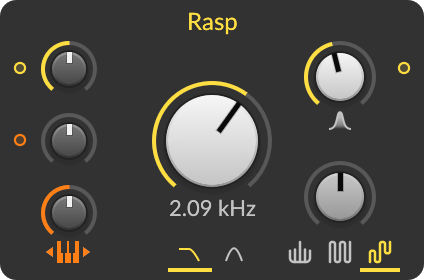
A character filter that layers movable resonant peaks around a low-pass or band-pass core for soft throatiness or aggressive screaming tones.
What it does
Rasp concentrates extra resonances around Cutoff. Brightness moves those peaks from harmonic toward inharmonic relationships, Mode determines how they move, and Feedback Limit controls how strongly the internal circuit reinforces them.
Controls and ports
| Control | Label | Official description |
|---|---|---|
brightness |
Brightness | Amount that resonant peaks shift, from harmonic to inharmonic relationships. Affected by the Brightness Mode. |
mode |
Mode | How resonant peaks move (via Brightness amount): |
fb_limit |
Fb Limit | Amount of feedback received by the internal filter, for a kind of resonance intensity |
Practical uses
- Start with low Feedback Limit, then raise Brightness to hear how the peak pattern changes before adding more resonance.
- Modulate Brightness for vocal, metallic, or growling movement around a stable fundamental Cutoff.
- Use restrained Drive for a whimpering nasal tone or push the feedback controls for screams and unstable textures.
Things to know
- Brightness changes relationships among several peaks, not merely the amount of high-frequency shelving.
- Brightness Mode changes the trajectory of those peaks, so the same Brightness value can produce a different spectrum.
- Feedback Limit acts like resonance intensity inside the circuit and can interact strongly with input level and Drive.
- The exact low-pass/band-pass core, mode algorithms, and stability limits are not present in the recovered Nitro corpus.
Technical details
No Nitro implementation has been confirmed for this visible module. The behavior is described conservatively from module metadata and editorial research.
The observed contract is a multi-resonance character filter centered around Cutoff. Brightness continuously moves resonant peaks between more harmonic and more inharmonic spacing, Mode selects the movement rule, and Feedback Limit bounds or scales an internal feedback path. This supports a conceptual model of a primary filter core plus a controlled bank or nested loop of resonant stages. No dedicated Nitro source was recovered, so exact coefficients, peak count, nonlinear limiting, oversampling, and mode definitions remain unknown.
Open questions
- Map every Brightness Mode with swept-sine measurements and track each resonant peak across the full Brightness range.
- Measure low-pass versus band-pass behavior, Feedback Limit, self-oscillation, Drive harmonics, and overload recovery.
- Test phase, stereo response, modulation smoothing, latency, sample-rate scaling, initialization, and CPU cost.
Version and sources
Checked against Bitwig Studio 6.0.6. This page combines Bitwig's module metadata, the existing Grid course and guides, and Nitro analysis where the mapping is strong enough to support a technical statement.
Related material
Return to Bitwig Grid Modules or the Grid Modules course lesson.
Also matches: Bitwig Rasp module, Bitwig Grid Rasp, Rasp Grid module