Fizz
Bitwig Platform
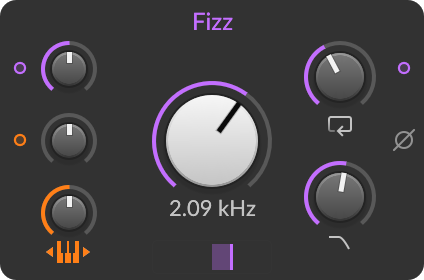
A nested character filter that places several formant-like resonant nodes inside a stereo low-pass response.
What it does
Fizz combines low-pass filtering with nested resonant or all-pass-like stages. Color moves and varies the internal peaks, producing tones that range from a solid low-pass bump to nasal formants, sparkling resonances, or phaser-like shimmer.
Controls and ports
| Control | Label | Official description |
|---|---|---|
alt |
Alt | Uses a variation of circuit, with different orientation and frequency responses |
color |
Color | Shift control for the placement and variation of formant peaks |
Practical uses
- Sweep Color slowly on sustained material to reveal the moving internal peaks.
- Use moderate Resonance on pads or noise for stereo shimmer without relying on a separate phaser.
- Toggle Alt after setting Cutoff and Color, because it changes the circuit response rather than adding a subtle variation.
Things to know
- Fizz is a character circuit, not a conventional low-pass with one clean resonant peak.
- Color changes the placement and variation of multiple formant peaks.
- Alt changes circuit orientation and frequency response, so its effect depends strongly on Cutoff, Color, and Resonance.
- No dedicated Nitro body was recovered, so exact topology, stereo offsets, nonlinear stages, and control laws remain unverified.
Technical details
No Nitro implementation has been confirmed for this visible module. The behavior is described conservatively from module metadata and editorial research.
Installed metadata identifies a nested, stereo, resonant low-pass circuit involving multiple peaks and all-pass/formant-like behavior. A safe conceptual model is a low-pass core plus several coupled frequency-selective stages whose positions are controlled by Color and whose orientation changes under Alt. This explains the audible bump, nasal, sparkling, and phasey regions without claiming a specific equation. The local Nitro corpus contains no dedicated Fizz implementation, so pole count, feedback routing, nonlinearity, oversampling, and stereo coupling require measurement.
Open questions
- Measure magnitude, phase, impulse, and stereo response across Cutoff, Color, Resonance, Drive, and Alt.
- Determine peak count, harmonic or inharmonic spacing, topology changes, self-oscillation, and nonlinear behavior.
- Test modulation smoothing, latency, sample-rate scaling, mono compatibility, initialization, and CPU cost.
Version and sources
Checked against Bitwig Studio 6.0.6. This page combines Bitwig's module metadata, the existing Grid course and guides, and Nitro analysis where the mapping is strong enough to support a technical statement.
Related material
Return to Bitwig Grid Modules or the Grid Modules course lesson.
Also matches: Bitwig Fizz module, Bitwig Grid Fizz, Fizz Grid module