XP
Bitwig Platform
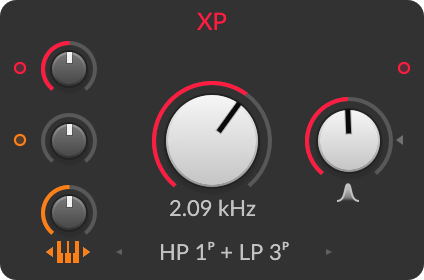
An Oberheim-inspired four-stage multimode filter that mixes internal ladder taps into 15 distinct responses.
What it does
XP runs the signal through a resonant four-stage low-pass ladder, then combines the input and each stage with a mode-specific set of coefficients. Those combinations produce 15 low-pass, high-pass, band-pass, notch, peak, and hybrid shapes from the same underlying filter state.
Controls and ports
Audio In feeds a four-stage core. Cutoff, Resonance, Drive, cutoff modulation, and the 15-position Type selector determine the response; Audio Out returns the gain-compensated tap mixture.
Practical uses
- Audition the modes at modest Resonance first so their different shapes are easy to compare.
- Sweep Cutoff after selecting a hybrid or notch mode for movement that a plain low-pass cannot produce.
- Use Drive and high Resonance for Oberheim-style animated peaks, then compensate level after the module if necessary.
Things to know
- The modes are weighted sums of ladder taps, not 15 unrelated filter engines.
- Each mode has its own input/output normalization, so loudness is intentionally compensated but not guaranteed identical.
- Drive enters before a soft nonlinear function inside the resonant core.
- Changing Type changes magnitude and phase immediately and may click when automated.
Technical details
A high-confidence Nitro implementation candidate supports the technical summary, but the visible-module mapping remains inferred.
The matching filter/xpander body processes a four-integrator ladder at 4x oversampling. After solving the resonant input, it obtains the unfiltered value A and low-pass taps B through E. Each of the 15 modes calculates y = c0*A + c1*B + c2*C + c3*D + c4*E from a fixed coefficient row, with a corresponding input/output gain pair. Resonance is frequency-stabilized and the inner signal passes through 2*clipLevel*y/(1.025+|y|) after Drive normalization. This tap-mixing structure explains the broad family of low-, high-, band-, notch-, peak-, and compound responses.
| Nitro port | Type |
|---|---|
in |
InputAudioPortType |
pitch |
InputAudioPortType |
resonance |
InputAudioPortType |
freqMod |
InputAudioPortType |
freqModAmount |
InputAudioPortType |
type |
InputValuePortType |
drive |
InputAudioPortType |
clipLevel |
InputAudioPortType |
out |
OutputAudioPortType |
Open questions
- Map the 15 visible Type names and order to the recovered coefficient rows and render their exact frequency responses.
- Measure cutoff, resonance, self-oscillation, mode normalization, Drive harmonics, and automation discontinuities.
- Confirm wrapper binding, smoothing, stereo independence, latency, and response near Nyquist.
Version and sources
Checked against Bitwig Studio 6.0.6. This page combines Bitwig's module metadata, the existing Grid course and guides, and Nitro analysis where the mapping is strong enough to support a technical statement.
Related material
Return to Bitwig Grid Modules or the Grid Modules course lesson.
Also matches: Bitwig XP module, Bitwig Grid XP, XP Grid module