Sallen-Key
Bitwig Platform
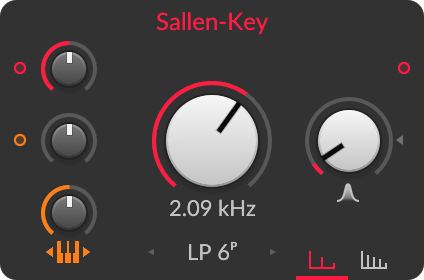
A resonant multimode filter with 16 low-pass, band-pass, and high-pass configurations from one to eight poles.
What it does
Sallen-Key combines cascaded low-pass and high-pass stages around a resonant core. Its 16 modes cover gentle one-pole responses, steep eight-pole responses, and several band-pass widths while retaining Drive and selectable nonlinear behavior.
Controls and ports
Audio In passes through Cutoff, Resonance, cutoff modulation, Drive, Character, and Mode controls. The Mode menu provides LP1/2/3/4/6/8, BP2/4/6/8, and HP1/2/3/4/6/8 configurations; Audio Out returns the selected response.
Practical uses
- Start with LP4 after a saw wave for a conventional subtractive synthesizer.
- Choose fewer poles for broad tone shaping and more poles for stronger band separation.
- Use the band-pass modes on noise or feedback, then raise Resonance to make a tuned resonator.
Things to know
- Pole count changes both transition steepness and phase shift; it is not simply a gain setting.
- The 16 modes comprise six low-pass, four band-pass, and six high-pass configurations.
- Drive and Character sit in the resonant structure, so input level can alter the cutoff-region behavior.
- Very high resonance may expose the implementation's tiny anti-denormal noise and nonlinear stabilization.
Technical details
A high-confidence Nitro implementation candidate supports the technical summary, but the visible-module mapping remains inferred.
The mapped filter/SallenKey implementation runs at 4x oversampling and constructs every mode from up to eight one-pole low-pass and high-pass stages. Its explicit mode constants are LP1/2/3/4/6/8, BP2/4/6/8, and HP1/2/3/4/6/8. Pitch uses 440*2^((p-69)/12) and is capped at 142. Resonance forms a shared feedback core whose scaling changes with frequency and nonlinear mode. Character chooses a symmetric tanh approximation, an asymmetric Class-A-style function, or a linear path; Drive is applied before that loop.
| Nitro port | Type |
|---|---|
in |
InputAudioPortType |
pitch |
InputAudioPortType |
resonance |
InputAudioPortType |
freqMod |
InputAudioPortType |
freqModAmount |
InputAudioPortType |
nonlin |
InputValuePortType |
poles |
InputValuePortType |
drive |
InputAudioPortType |
clipLevel |
InputAudioPortType |
out |
OutputAudioPortType |
Open questions
- Render impulse and swept-sine responses for all 16 modes to verify nominal slopes, cutoff reference, phase, and gain.
- Measure resonance and self-oscillation across mode, Character, Drive, sample rate, and cutoff extremes.
- Confirm visible Character labels, modulation bandwidth, smoothing, stereo behavior, latency, and idle noise floor.
Version and sources
Checked against Bitwig Studio 6.0.6. This page combines Bitwig's module metadata, the existing Grid course and guides, and Nitro analysis where the mapping is strong enough to support a technical statement.
Related material
- Grid Modules course reference
- Poly Grid - Basic Subtractive Synth
- Filter+ - Modular Polyphonic Distortion & Filter Effect
Return to Bitwig Grid Modules or the Grid Modules course lesson.
Also matches: Bitwig Sallen-Key module, Bitwig Grid Sallen-Key, Sallen-Key Grid module