SVF
Bitwig Platform
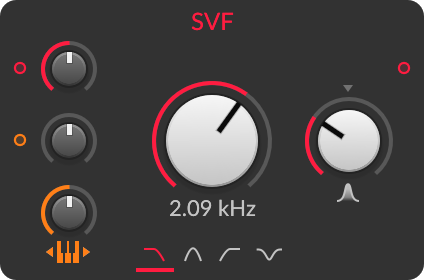
A resonant state-variable filter that derives several low-pass, band-pass, high-pass, and rejection responses from one shared state.
What it does
SVF calculates multiple simultaneous filter states around one Cutoff and selects a response from their combinations. It is a compact choice when you want to switch between standard filter shapes while keeping the same resonant core and modulation behavior.
Controls and ports
| Control | Label | Official description |
|---|---|---|
cutoff |
Cutoff | Frequency where 3 dB of attenuation occurs (or the center frequency for band-pass modes) |
Practical uses
- Switch modes while keeping Cutoff modulation intact to compare complementary spectral shapes.
- Use band-pass on noise or rich oscillators to isolate a moving resonant band.
- Increase Drive and Resonance for pings, liquid sweeps, and self-resonant textures.
Things to know
- The modes are algebraic combinations of shared internal states, so they remain closely phase-related.
- Bitwig defines Cutoff at the 3 dB point, or as center frequency for band-pass modes.
- Drive precedes the recursive state update and therefore interacts with the internal dynamic limiter.
- High resonance is stabilized nonlinearly, so its response is not a perfectly linear textbook SVF.
Technical details
A high-confidence Nitro implementation candidate supports the technical summary, but the visible-module mapping remains inferred.
The exact-name filter/SVF candidate runs at 4x oversampling and computes a two-integrator state-variable structure. It uses k = 2-2*resonance, obtains a pitch-derived coefficient g, and updates band-like state v1 and low-pass state v2; the selected output is then formed from v0, v1, v2, and k. A state-dependent limiter multiplies the integrator states by max(0.1, 1-v1²*limit), with the limit tied to resonance, clip level, and g. A tiny random term is injected into the recursive state.
| Nitro port | Type |
|---|---|
in |
InputAudioPortType |
freq |
InputAudioPortType |
resonance |
InputAudioPortType |
freqMod |
InputAudioPortType |
freqModAmount |
InputAudioPortType |
drive |
InputAudioPortType |
filterType |
InputValuePortType |
clipLevel |
InputAudioPortType |
out |
OutputAudioPortType |
Open questions
- Map every visible Type label to the five internal output cases and verify which case, if any, is hidden from the Grid module.
- Measure cutoff calibration, Q/self-oscillation, mode gain, phase, Drive harmonics, and modulation bandwidth.
- Confirm smoothing, stereo lanes, latency, reset behavior, and response near minimum and maximum Cutoff.
Version and sources
Checked against Bitwig Studio 6.0.6. This page combines Bitwig's module metadata, the existing Grid course and guides, and Nitro analysis where the mapping is strong enough to support a technical statement.
Related material
Return to Bitwig Grid Modules or the Grid Modules course lesson.
Also matches: Bitwig SVF module, Bitwig Grid SVF, SVF Grid module