Comb
Bitwig Platform
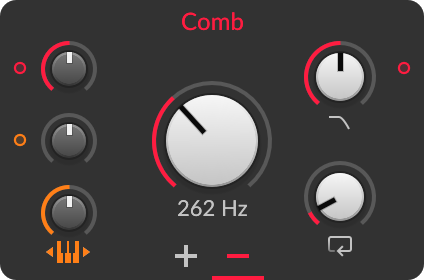
A tuned feedback delay that creates regularly spaced peaks or notches, with polarity and damping controls for the tail.
What it does
Comb delays the signal by one period of the selected Cutoff frequency and feeds the delayed result back. Interference between present and delayed audio creates a harmonic comb of peaks or notches; feedback polarity shifts that pattern, while damping removes high frequencies from later repeats.
Controls and ports
| Control | Label | Official description |
|---|---|---|
cutoff |
Cutoff | Frequency where 3 dB of attenuation occurs |
reso |
Reso | Amount of feedback applied within the filter |
damp |
Damp | Cutoff frequency of a low-pass filter applied in the feedback loop. Value is set relative to the Comb's current cutoff frequency, with lower values resulting in more dampening. |
feedback_invert |
Feedback Polarity [normal or inverted] | Sign used for scaling feedback |
Practical uses
- Send a short impulse or noise burst into Comb to create a pitched, string-like resonance.
- Key-track Cutoff so the delay resonance follows played notes.
- Lower Damp for darker decays, and flip Feedback Polarity to move peaks and notches to a different harmonic series.
Things to know
- Cutoff is really the inverse of delay time: higher frequency means a shorter delay.
- Feedback polarity changes the resonance series; the recovered newer path adds one octave internally for inverted polarity to preserve the visible tuning convention.
- Damp is relative to the current Cutoff, so changing pitch also moves the feedback low-pass.
- High feedback and Drive can sustain, distort, or become unstable; reduce input level before assuming the Cutoff is inaccurate.
Technical details
A high-confidence Nitro implementation candidate supports the technical summary, but the visible-module mapping remains inferred.
The exact filter/comb candidate uses T = 1/440 * 2^(-(p-69)/12) and a 4x-rate FIR delay. Feedback is calculated as FB = sign * 0.001^(T/|decayTime|), so the requested decay reaches -60 dB after the configured time. In the current revision, inverted polarity adds 12 semitones before period conversion. The delayed signal passes through a one-pole low-pass whose coefficient depends on Damp and pitch, and the feedback write is limited by a scaled tanh approximation. The delay buffer contains 131072 samples.
| Nitro port | Type |
|---|---|
in |
InputAudioPortType |
freq |
InputAudioPortType |
decayTime |
InputAudioPortType |
freqMod |
InputAudioPortType |
freqModAmount |
InputAudioPortType |
polarity |
InputValuePortType |
drive |
InputAudioPortType |
damp |
InputAudioPortType |
clipLevel |
InputAudioPortType |
out |
OutputAudioPortType |
dampOut |
OutputAudioPortType |
Open questions
- Measure visible Resonance/Decay mapping, pitch accuracy, polarity tuning, feedback decay, and damping at several sample rates.
- Test interpolation artifacts under fast Cutoff modulation, minimum delay, maximum feedback, and Drive overload.
- Confirm wrapper mode/revision, stereo lanes, initialization, latency, and whether Damp Out is exposed anywhere.
Version and sources
Checked against Bitwig Studio 6.0.6. This page combines Bitwig's module metadata, the existing Grid course and guides, and Nitro analysis where the mapping is strong enough to support a technical statement.
Related material
Return to Bitwig Grid Modules or the Grid Modules course lesson.
Also matches: Bitwig Comb module, Bitwig Grid Comb, Comb Grid module