Low-pass MG
Bitwig Platform
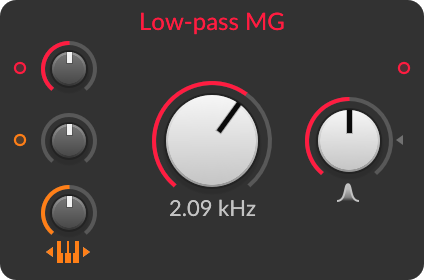
A fixed four-stage Moog-inspired low-pass whose drive and nonlinear feedback give it a rounded analog-style character.
What it does
Low-pass MG rolls off frequencies above Cutoff through a four-stage ladder and emphasizes the cutoff with Resonance. Unlike the more configurable LD version, it commits to one nonlinear model so Drive, feedback, and output color behave as one instrument-like circuit.
Controls and ports
Audio In feeds the ladder. Cutoff and cutoff modulation tune it, Resonance controls feedback, Drive sets how hard the nonlinear circuit is hit, and Audio Out carries the four-pole low-pass result.
Practical uses
- Use it when you want a quick four-pole low-pass character without choosing slope and nonlinear model separately.
- Drive a bass, drum bus, or oscillator into it for saturation that changes with Cutoff and Resonance.
- Push Resonance and key-track Cutoff to turn the filter peak into a pitched or nearly self-oscillating element.
Things to know
- Drive is part of the filter circuit, so matching output level does not remove its tonal effect.
- The mapped implementation saturates both the input/output flavor and individual feedback-stage states.
- A resonant ladder can lose apparent low-frequency weight as resonance increases; judge it in context rather than by peak loudness alone.
- This module has a fixed four-stage response rather than Low-pass LD's selectable pole count.
Technical details
A high-confidence Nitro implementation candidate supports the technical summary, but the visible-module mapping remains inferred.
The inferred filter/GrandLPF match is a 4x-oversampled four-stage ladder using the same pitch conversion and TPT-style coefficient family as LD. Its resonance coefficient is k = 4*r with frequency-dependent stabilization. Each integrator state passes through an antiderivative-antialiasing soft clip after an asymmetric quadratic term, while a fixed GRANDMOTHER flavor processes the input and output. The input is normalized by 4.2*clipLevel before the circuit and scaled back afterward. This establishes nonlinear behavior inside the recursive ladder rather than a separate post-filter saturator.
| Nitro port | Type |
|---|---|
in |
InputAudioPortType |
pitch |
InputAudioPortType |
resonance |
InputAudioPortType |
freqMod |
InputAudioPortType |
freqModAmount |
InputAudioPortType |
drive |
InputAudioPortType |
clipLevel |
InputAudioPortType |
out |
OutputAudioPortType |
Open questions
- Confirm that the visible Low-pass MG wrapper binds to
GrandLPFand measure the correspondence between visible Drive and its internal drive/clip-level ports. - Measure cutoff, resonance, self-oscillation, low-end compensation, noise floor, and harmonic balance at several sample rates.
- Test fast cutoff modulation, stereo independence, parameter smoothing, initialization, and overload recovery.
Version and sources
Checked against Bitwig Studio 6.0.6. This page combines Bitwig's module metadata, the existing Grid course and guides, and Nitro analysis where the mapping is strong enough to support a technical statement.
Related material
Return to Bitwig Grid Modules or the Grid Modules course lesson.
Also matches: Bitwig Low-pass MG module, Bitwig Grid Low-pass MG, Low-pass MG Grid module