Ripple
Bitwig Platform
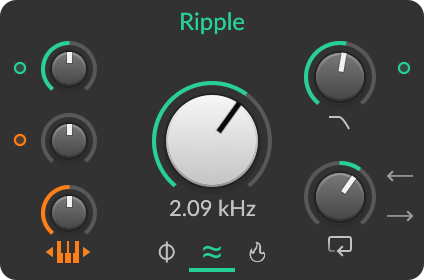
A hyper-resonant feedback/feedforward character filter designed for strong peaks, subharmonics, unstable motion, and distortion.
What it does
Ripple combines feedback and feedforward paths around a selectable filter model. Resonance can be positive or negative for different colors, the two Alt controls reshape the return and forward paths, and Lo-fi loosens tuning while reducing processor load.
Controls and ports
| Control | Label | Official description |
|---|---|---|
mode |
Mode | Model for this filter: |
reso |
Reso | Amount of feedback applied within the filter, with positive and negative values providing different colors |
fb_alt |
Fb Alt | Modifies the feedback circuit, which could either dampen or expand resonance (depending on the other parameters) |
ff_alt |
Ff Alt | Modifies the feedforward circuit, which could either dampen or expand resonance (depending on the other parameters) |
lo-fi |
Lo-Fi | Loosens the tuning a bit (and reduces the processor load) |
Practical uses
- Move Resonance slowly through zero to compare positive and negative feedback colors.
- Treat FB Alt and FF Alt as interacting circuit controls and explore them one at a time before modulating both.
- Use Lo-fi deliberately for rougher subharmonic or distorted textures, not only as a CPU-saving switch.
Things to know
- Ripple is intentionally capable of extreme feedback, subharmonics, and distortion; output level can change abruptly.
- Positive and negative Resonance are different feedback polarities, not interchangeable amounts.
- FB Alt and FF Alt can either damp or enlarge resonances depending on the other settings.
- Lo-fi changes tuning precision as well as processing load, and the exact internal models are not exposed in the local Nitro corpus.
Technical details
No Nitro implementation has been confirmed for this visible module. The behavior is described conservatively from module metadata and editorial research.
Installed metadata establishes a model-selectable, hyper-resonant circuit with distinct feedback and feedforward modifications, bipolar feedback, and a lower-precision mode. Those controls imply at least one recursive path plus a forward cancellation or reinforcement path, capable of period multiplication/subharmonics and nonlinear limiting. Without a dedicated Nitro body, it is not safe to specify the filter topology, delay lengths, coefficient quantization, oversampling, or exact reason Lo-fi reduces CPU.
Open questions
- Document every Model and measure magnitude, phase, impulse, pitch tracking, and distortion across bipolar Resonance.
- Isolate FB Alt and FF Alt to recover their routing, stability boundaries, subharmonic conditions, and interaction with Drive.
- Quantify Lo-fi tuning error and CPU reduction, plus stereo behavior, smoothing, latency, sample-rate scaling, and overload recovery.
Version and sources
Checked against Bitwig Studio 6.0.6. This page combines Bitwig's module metadata, the existing Grid course and guides, and Nitro analysis where the mapping is strong enough to support a technical statement.
Related material
Return to Bitwig Grid Modules or the Grid Modules course lesson.
Also matches: Bitwig Ripple module, Bitwig Grid Ripple, Ripple Grid module