Dome
Bitwig Platform
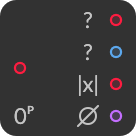
A multi-quality Hilbert transformer that exposes real, quadrature-imaginary, magnitude, and normalized phase signals.
What it does
The current editorial summary is: A multi-quality Hilbert transformer that exposes real, quadrature-imaginary, magnitude, and normalized phase signals.
Dome turns each input channel into an analytic-signal-style representation. Real and Imaginary are approximately 90 degrees apart, Magnitude estimates their combined amplitude, and Phase reports the instantaneous angle, enabling quadrature processing, frequency shifting, analysis, and experimental resynthesis.
Controls and ports
| Control | Label | Official description |
|---|---|---|
filter_quality |
Filter Quality | Type of filter being used: |
pole_count |
Filter Quality [display] | Visualization of the Filter Quality setting, which can be changed in the Inspector Panel |
real |
Real | Real part of the incoming signal |
imaginary |
Imaginary | Imaginary part of the incoming signal |
magnitude |
Magnitude | Magnitude of the incoming signal |
phase |
Phase | Detected phase of the incoming signal |
Practical uses
- Combine Real and Imaginary with sine/cosine modulation to build a frequency shifter.
- Use Magnitude to control the level of a signal reconstructed from the Phase output.
- Mix a processed quadrature output with the dry signal for phase cancellation, widening, or notch-like effects.
- Combine Real and Imaginary with sine/cosine modulation to build a frequency shifter or single-sideband effect.
- Use Magnitude to scale a phase-derived sine when experimenting with analysis and resynthesis.
- Blend Real with the dry signal for phase-cancellation shapes, or process left and right differently for stereo widening.
Things to know
- The imaginary path is approximately 90 degrees from the real path over the useful frequency range; it is not a fixed time delay.
- Higher Filter Quality selects a larger Hilbert network, improving broadband accuracy at additional processing cost.
- Phase becomes unstable or musically meaningless when Magnitude is near zero.
- The mapped implementation runs its Hilbert networks at four-times oversampling.
- Dome is not an FFT: it produces one broadband analytic representation per channel rather than independent frequency bins.
- Higher Filter Quality uses more Hilbert sections, improving the quadrature approximation while increasing phase complexity and processing cost.
- Phase is normalized to roughly 0 through 1 and wraps at the angle boundary; it is not a continuous unwrapped phase trajectory.
- Real and Imaginary are delayed/phase-shaped approximations, so neither should be assumed sample-aligned with the original input.
Technical details
A high-confidence Nitro implementation candidate supports the technical summary, but the visible-module mapping remains inferred.
The exact filter/Dome implementation runs four quality-specific zero-delay Hilbert networks at 4x oversampling: 6, 12, 18, or 24 sections selected by internal Type values 0, 1, 2, or 4. It obtains Real, Imaginary, and Magnitude from the selected network, then computes normalized Phase as 0.5 + atan2(real, imaginary)/(2*pi). Real and Imaginary are negated at the exported ports; Magnitude and Phase are not. State is reset and zero-predicted at initialization. This confirms a Hilbert-transform approximation, not a spectral-bin transform.
| Nitro port | Type |
|---|---|
audio_in |
InputAudioPortType |
type |
InputValuePortType |
real_out |
OutputAudioPortType |
imag_out |
OutputAudioPortType |
mag_out |
OutputAudioPortType |
phase_out |
OutputAudioPortType |
Open questions
- Measure latency and quadrature error across frequency for all four quality settings and common sample rates.
- Measure quadrature error, magnitude ripple, group delay, latency, and useful bandwidth for all four quality settings and sample rates.
- Verify phase orientation, wrap boundary, silence behavior, transient settling, channel independence, and sign conventions.
- Quantify CPU cost and reconstruction error for frequency shifting and phase/magnitude resynthesis patches.
Version and sources
Checked against Bitwig Studio 6.0.6. This page combines Bitwig's module metadata, the existing Grid course and guides, and Nitro analysis where the mapping is strong enough to support a technical statement.
Related material
Return to Bitwig Grid Modules or the Grid Modules course lesson.
Also matches: Bitwig Dome module, Bitwig Grid Dome, Dome Grid module