Low-pass LD
Bitwig Platform
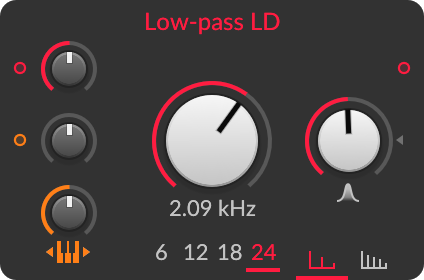
A resonant ladder low-pass with selectable pole count and optional symmetric, asymmetric, or linear feedback behavior.
What it does
Low-pass LD removes frequencies above Cutoff with a ladder-style cascade. Resonance feeds energy around the cutoff back into the ladder, Pole count changes the transition steepness, and the nonlinear modes let Drive alter the tone as well as the level.
Controls and ports
Audio In enters the filter; Cutoff and its modulation input set the corner frequency; Resonance controls the feedback peak; Poles selects one through four low-pass stages; Character selects symmetric, asymmetric, or linear processing; Drive pushes the loop; Audio Out returns the result.
Practical uses
- Place it after a harmonically rich oscillator for a classic subtractive-synthesis voice.
- Use fewer poles for a broad, gentle roll-off and four poles for stronger high-frequency removal.
- Raise Drive in a nonlinear Character mode to make resonance and input level interact rather than merely turning the output up.
Things to know
- Each pole contributes another low-pass stage, so the mode changes both slope and phase response.
- Resonance is inside a nonlinear feedback loop and can change loudness, stability, and timbre at high settings.
- The asymmetric Character mode does not treat positive and negative signal excursions equally.
- Cutoff modulation is converted to a pitch offset before frequency conversion, making octave-related modulation musically useful.
Technical details
A high-confidence Nitro implementation candidate supports the technical summary, but the visible-module mapping remains inferred.
The matching filter/LDLPF body is a four-stage topology-preserving ladder processed at 4x oversampling. It converts pitch with f = 440 * 2^((p-69)/12), caps pitch at 142, forms G = g/(1+g) from a cubic tangent approximation, and takes its output after stage 1, 2, 3, or 4. Resonance feeds a weighted sum of all four integrator states back to the input with k = 4*sqrt(r) plus high-frequency stabilization. Character 0 uses a scaled seventh-order tanh approximation, Character 1 uses a biased Class-A-style curve, and the remaining path is linear. A tiny random term prevents denormal buildup in the recursive state.
| Nitro port | Type |
|---|---|
in |
InputAudioPortType |
pitch |
InputAudioPortType |
resonance |
InputAudioPortType |
freqMod |
InputAudioPortType |
freqModAmount |
InputAudioPortType |
nonlin |
InputValuePortType |
poles |
InputValuePortType |
drive |
InputAudioPortType |
clipLevel |
InputAudioPortType |
out |
OutputAudioPortType |
Open questions
- Measure the visible pole labels, cutoff calibration, resonance onset, self-oscillation, and gain compensation for every Character.
- Compare harmonic spectra and DC offset of symmetric, asymmetric, and linear modes across Drive levels.
- Confirm parameter smoothing, modulation bandwidth, stereo independence, latency, and behavior near Nyquist.
Version and sources
Checked against Bitwig Studio 6.0.6. This page combines Bitwig's module metadata, the existing Grid course and guides, and Nitro analysis where the mapping is strong enough to support a technical statement.
Related material
Return to Bitwig Grid Modules or the Grid Modules course lesson.
Also matches: Bitwig Low-pass LD module, Bitwig Grid Low-pass LD, Low-pass LD Grid module