
Jan 27, 2026 Bitwig Guide
The organ device in Bitwig Studio is a simple additive synthesizer that allows you to stack up to nine sine wave partials using sliders, offering pitch, glide, attack, release, gain, and panning controls. While it is not designed to emulate traditional organs, its easy layout and oscillator model options make it versatile for creating pad sounds, bass lines, and experimental textures, especially when combined with modulators and voice stacking. Despite its age and simplicity, it remains a useful tool for creative sound design within Bitwig Studio.
Nov 07, 2023 Tutorial
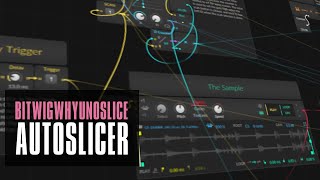
In this video, I discuss the limitations of the sampling mode in Bitwig Studio, particularly the lack of a slicing feature. To overcome this, I demonstrate how I created a custom slicer within the Bitwig Grid, allowing for easy mapping of slices onto the MIDI keyboard. I provide an overview of the patch and explain the functions of the transient detector, slice mapping, and play triggers.
Apr 17, 2023 Tutorial
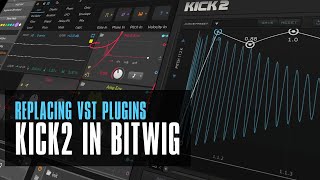
In this video, I show how to replace Kick 2 with basic grid patching in Bitwig Studio. I demonstrate how to recreate the functions of Kick 2 using the grid, including the oscillator, envelopes, click sound, EQ, distortion, and more. This offers more flexibility and customization options compared to using Kick 2, allowing users to create their own unique kick drum sounds.

Mär 03, 2023 Bitwig Guide
The Bitwig Studio Test Tone device is a versatile tool that generates various sounds like sine, triangle, square, saw, white noise, pink noise, and direct impulses, making it ideal for testing speakers, effect chains, or system setups. Clever use of modulation and containers allows you to transform it into monophonic or polyphonic synthesizers, customize sound shaping with macros and envelopes, and even create impulse responses for convolution effects. Additionally, the Test Tone can be creatively combined with devices like ring modulators for unique sound design possibilities.

Feb 28, 2023 Bitwig Guide
The DC Offset device in Bitwig Studio is a simple tool designed to correct DC offsets in audio recordings but becomes much more powerful with modulation, enabling creative sound design techniques like custom synthesizers, saturation, and bit-crushing effects. By converting audio signals into modulation sources, users can reshape, process, and reintroduce signals in unique ways, utilizing the full range of Bitwig modulators. This foundational device, while basic in concept, opens the door to a variety of experimental audio effects and advanced signal manipulation.

Mai 09, 2022 Bitwig Guide
The Bitwig Studio Polysynth features two identical oscillators with flexible waveform shaping, unison, sync, blend operators, and the ability to blend with noise and modulate filter parameters. It offers robust filtering options, two envelope generators for amplitude and filter shaping, and extensive modulation and voice control for a highly customizable sound. Additional options and voice modes can be accessed through the inspector panel, providing versatile sound design capabilities.